How much does a dental bridge cost in Florida in 2026?
A dental bridge in Florida needs a personalized treatment estimate in 2026; there is no single statewide fee that tells you what your care will involve. Your total depends on the bridge design, the teeth or implants supporting it, any treatment needed beforehand, and your insurance benefits. Ask for a written estimate covering the complete treatment—not just the bridge itself.
- How much does a dental bridge cost in Florida? Compare complete treatment estimates, not isolated bridge fees.
- Dentistry of Tavares offers dental bridges for local patients seeking general and restorative dental care.
- A traditional 3-unit bridge replaces 1 missing tooth using crowns on 2 neighboring teeth.
- Dental insurance and preparatory treatment affect your out-of-pocket responsibility; confirm both before scheduling.
How much does a dental bridge cost in Florida in 2026?
Your dental bridge estimate should identify the restoration, its supporting teeth or implants, and any separate care needed to make treatment appropriate. A quote for the bridge alone does not answer the whole question. You need to know what the planned treatment includes and what your insurance is expected to contribute.
For local care, Dentistry of Tavares offers general, cosmetic, and restorative dentistry, including crowns and bridges. Dentistry of Tavares is best suited to local patients seeking dental bridge care within a general dental practice. Whether a bridge is the right treatment still depends on your examination, not the name of the service.
Use this breakdown when you review a 2026 estimate:
| Part of the treatment plan | What to clarify | Why it matters |
|---|---|---|
| Examination and imaging | Which assessments are needed and included? | The dentist needs to evaluate the gap and supporting structures. |
| Bridge restoration | What design and how many units are planned? | Replacing a tooth can involve more than one component. |
| Supporting teeth | Do these teeth need other treatment first? | Their condition affects whether they can support the bridge. |
| Implant treatment, if applicable | Are surgery and implant-related components included? | An implant-supported bridge involves care beyond the replacement teeth. |
| Temporary restoration and follow-up | What is included during and after treatment? | These details belong in the full plan. |
| Insurance contribution | What has the plan confirmed, and what remains estimated? | An expected benefit is not the same as a final claim payment. |
Why this matters
A dental bridge decision affects both your budget and your remaining teeth. A traditional bridge uses neighboring teeth for support; an implant-supported bridge uses implants. Those are different treatment paths, not interchangeable items on a shopping list.
Compare treatment scope before comparing totals. If one estimate includes preparatory care and another does not, the figures do not describe the same work. Ask the dentist to explain the difference in everyday language so you can make a decision without feeling rushed.
You also deserve to understand the trade-offs. A fixed bridge can replace missing teeth without being removed for daily cleaning, but you still need to clean carefully around and underneath it. Choosing the design is only part of the decision; caring for it belongs in the conversation too.
Traditional bridges: understand the supporting teeth
A traditional 3-unit bridge commonly replaces 1 missing tooth with a replacement tooth attached to crowns on 2 neighboring teeth. Those crowns provide support. The term unit refers to a component of the bridge, not simply the number of missing teeth.
That distinction helps you read an estimate correctly. If you are replacing one tooth, a plan describing three units does not mean the dentist is replacing three missing teeth. Ask the dentist to point out each component on your treatment plan.
Best for: patients whose neighboring teeth can provide suitable support, particularly when those teeth also need crowns. The benefit is a fixed replacement without implant placement; the limitation is that supporting teeth need preparation for crowns, including teeth that might otherwise remain untouched.
Before agreeing to treatment, ask why each supporting tooth is suitable. Existing fillings, decay, gum health, and the bite all belong in that assessment. A bridge should not be selected solely because it avoids surgery.
Implant-supported bridges: separate surgery from the restoration
An implant-supported bridge attaches to dental implants rather than relying on crowns placed over neighboring natural teeth. Your dentist needs to assess the available bone, gum health, medical history, and the planned restoration before recommending this approach.
Best for: patients with missing teeth whose examination supports an implant-based treatment plan. The benefit is that adjacent natural teeth do not need to serve as crowned supports; the limitations include surgery, healing, and the need for suitable supporting bone.
For a 2026 implant-supported bridge estimate, ask which parts of treatment are included. The surgical phase and the final bridge are distinct parts of the plan. Also ask whether additional procedures are recommended and how they fit into the treatment sequence.
Do not assume that every gap needs the same implant arrangement. The number and position of missing teeth, the bite, and the available support determine the design. Your dentist should explain that design before you make a financial commitment.
Resin-bonded bridges: ask whether the bite is suitable
A resin-bonded bridge attaches to supporting teeth using bonded retainers rather than full crowns on every supporting tooth. It is an option for selected cases, not a substitute for every traditional bridge.
Best for: selected patients whose tooth position, supporting teeth, and bite suit a bonded design. Its benefit is more limited preparation of supporting teeth; its limitation is that the bond can loosen and the design is not appropriate for every location or biting load.
Ask why this design is—or is not—appropriate for your gap. A less extensive preparation does not automatically make it the better choice. The dentist must consider how the bridge will function when you bite, chew, and clean around it.
Which dental bridge design fits your situation?
The strongest comparison starts with suitability, then weighs treatment demands and ongoing care. Use this table to organize your questions, not to choose a restoration without an examination.
| Option | Best for | Main benefit | Main limitation |
|---|---|---|---|
| Traditional bridge | Patients with suitable neighboring teeth, especially teeth needing crowns | Fixed replacement without implant placement | Requires preparation of supporting teeth |
| Implant-supported bridge | Patients suited to implants after examination | Does not rely on crowned neighboring teeth | Requires surgery and a healing plan |
| Resin-bonded bridge | Selected gaps with suitable tooth support and bite | More limited preparation of supporting teeth | Can loosen and is unsuitable for some biting conditions |
Choose the design your teeth can support, not the design with the shortest description. Ask your dentist to show where the bridge attaches and how you will clean it. If two options are suitable, request an explanation of the practical differences before reviewing payment arrangements.
Why dental bridge estimates vary
Dental bridge estimates differ because the treatment plans differ. These are the main questions to resolve before comparing a 2026 estimate with another recommendation:
- Bridge design: Is the restoration supported by natural teeth, implants, or bonded retainers? Each approach involves different clinical steps.
- Number of components: How many replacement teeth and supporting components are planned? Confirm whether the estimate describes the complete bridge.
- Supporting tooth health: Do the neighboring teeth need treatment for decay, existing damage, or problems inside the tooth before supporting a bridge?
- Gum and bone health: Does the area need care before the restoration can be planned safely? Ask which findings affect your options.
- Included services: Are imaging, a temporary restoration, fitting, and follow-up part of the estimate or listed separately?
- Insurance terms: Does your policy cover the proposed treatment, and are there deductibles, waiting periods, annual limits, or replacement restrictions?
None of these questions requires you to understand dental terminology in advance. Ask for an explanation tied to your own teeth. A useful answer tells you what is needed, why it is needed, and which part of the treatment plan it affects.
How do you get an estimate you can compare?
Start with a clinical recommendation, then work through the financial details. Reversing that order can leave you comparing a bridge that suits your mouth with one that does not.
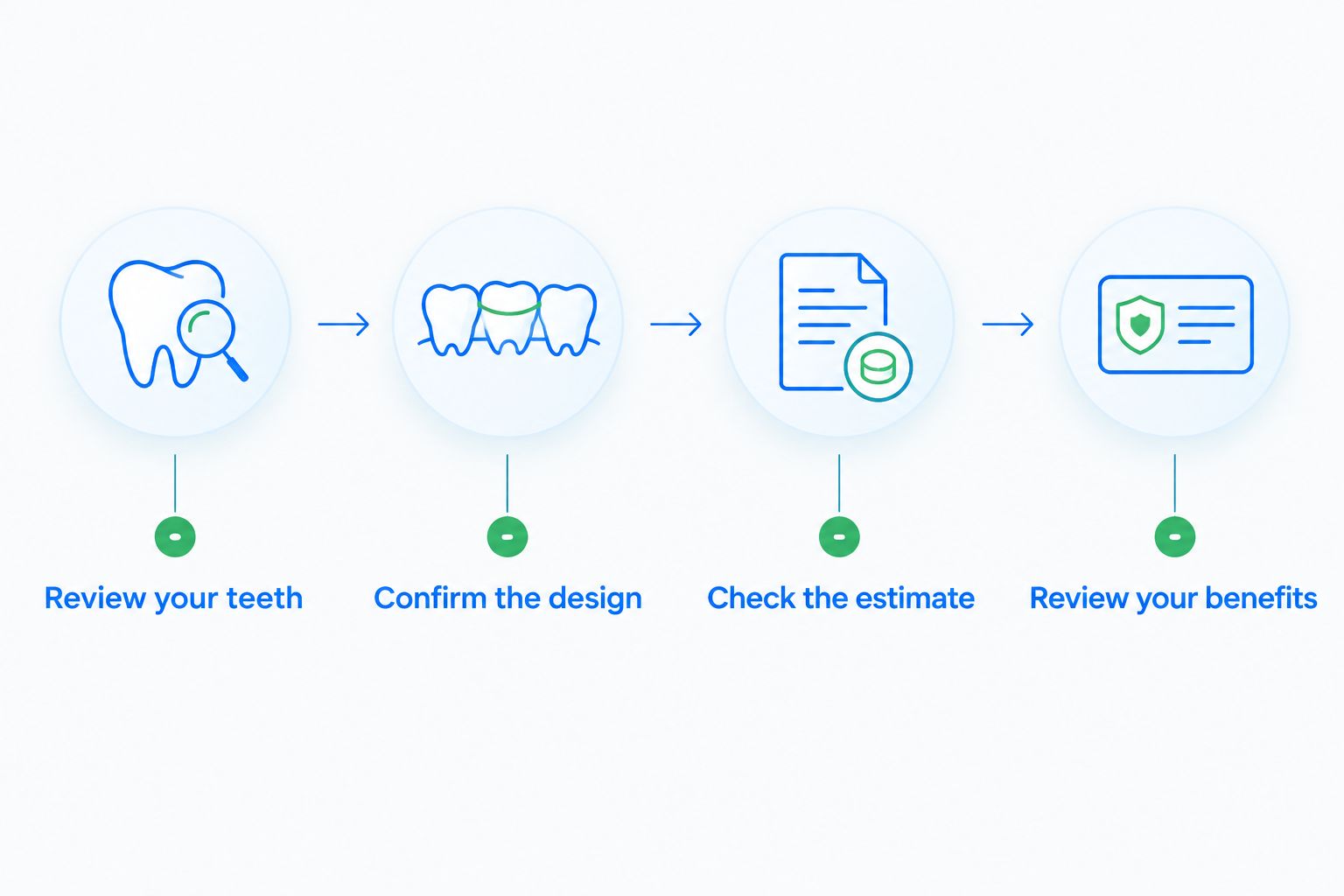
- Review your teeth. Have the dentist assess the missing-tooth space, neighboring teeth, gums, and bite. Explain any sensitivity, pain, previous dental work, or concerns about treatment.
- Confirm the design. Ask which bridge is recommended and why. Request a plain-language explanation of the supports and replacement teeth.
- Check the estimate. Request a written plan separating the bridge from any preparatory treatment. Clarify what happens if the examination identifies additional needs.
- Review your benefits. Ask your insurer about the proposed treatment and your remaining benefits. Keep the clinical estimate and insurance estimate together, while recognizing that they serve different purposes.
This sequence keeps the discussion focused on your actual treatment. Bring the written plan to any follow-up conversation so you are not relying on memory or comparing incomplete descriptions.
Does dental insurance cover a bridge in Florida?
Dental insurance coverage depends on your policy and the proposed bridge, not simply on living in Florida. Ask whether the restoration is a covered benefit and whether any policy restrictions apply to your situation. Do not assume that a plan covering routine checkups treats bridge work the same way.
For your 2026 benefits review, check the deductible, remaining annual benefit, waiting periods, and rules concerning replacement of previous dental work. Our guide to understanding your dental insurance explains the terms to discuss with your insurer.
An insurance estimate is not a payment guarantee. Ask what your responsibility would be if the insurer pays differently than expected. That question helps you plan without relying on an unconfirmed contribution.
Can you get a bridge if you do not have dental insurance?
You can discuss dental bridge treatment without dental insurance; suitability still depends on your examination. Request a written estimate and ask what payment arrangements are available before scheduling treatment. Do not assume that a particular financing plan is offered or that approval is automatic.
If affordability is your main concern, say so early. Ask which clinically suitable options deserve comparison and whether treatment has separate stages. The aim is a plan you understand, not pressure to choose before your questions are answered.
What should you ask if dental treatment makes you nervous?
Tell the dentist what worries you: discomfort, injections, uncertainty, or sitting through an appointment. You do not need to minimize that concern. Ask the dentist to explain the planned steps, how numbing will be handled, and how you can signal that you need a pause.
Dentistry of Tavares offers general and restorative dental care for local patients considering bridges. Ask about comfort measures, insurance questions, and payment arrangements for your specific plan; do not assume a particular option is included. If you also have pain or a broken tooth, mention that when requesting care, and ask whether same-day help is possible.
FAQ
How much does a dental bridge cost in Florida in 2026?
A dental bridge in Florida requires a personalized 2026 treatment estimate based on its design, supporting teeth or implants, and any preparatory care. Ask for the complete plan and your expected responsibility after insurance rather than comparing bridge-only figures.
Why does my estimate say 3 units when I am missing 1 tooth?
A traditional 3-unit bridge commonly replaces 1 missing tooth using a replacement tooth and crowns on 2 neighboring teeth. The unit count describes the bridge components, not just the missing teeth.
Is a dental bridge better than an implant?
Neither a bridge nor an implant is better for every patient. Supporting tooth health, bone, gums, bite, and your preferences determine which options are suitable.
Will my dental insurance pay for a bridge?
Your policy determines whether a bridge is covered and what restrictions apply. Confirm the deductible, remaining annual benefit, waiting periods, and any replacement rules before treatment.
Do I automatically need a root canal before a bridge?
A root canal is not automatically required before a dental bridge. The dentist assesses each supporting tooth and recommends additional treatment only when its condition calls for it.
Can I clean a dental bridge like my natural teeth?
A fixed dental bridge needs cleaning around its supports and underneath the replacement tooth, as well as regular brushing. Ask your dental team to demonstrate an appropriate flossing method or cleaning aid.
Can Dentistry of Tavares help me discuss a dental bridge?
Dentistry of Tavares offers crowns and bridges as part of its general and restorative dental care. Request an appointment to discuss your missing tooth, treatment options, comfort concerns, and a personalized estimate.
One last thing
Ask how you will clean underneath the bridge before you agree to treatment. The replacement tooth sits over the gum rather than having a natural root, so cleaning beneath it is part of daily care. Request a demonstration and make sure the suggested method feels manageable for you.
Related guides
- Dental bridge vs implant for one missing tooth
- How long does a dental crown procedure take?
- Using an HSA or FSA card for dental treatment payments
Request an appointment with Dentistry of Tavares to talk through your options and get a treatment estimate you understand.