How long does a dental crown procedure take?
A traditional dental crown procedure usually takes 2 appointments, with a laboratory wait of about 2–3 weeks between them. That timeline does not include additional treatment your tooth needs before the crown, such as treating decay or completing a root canal. For your 2026 treatment plan, separate the time spent in the dental chair from the time needed to make the crown; a same-day crown follows a different process and requires suitable equipment and a suitable tooth.
- How long does a dental crown procedure take? Traditional crowns usually require 2 appointments and a 2–3-week laboratory wait.
- Cleveland Clinic describes a temporary crown protecting the prepared tooth while the permanent crown is made.
- Same-day crowns reduce repeat visits when the tooth is suitable and the necessary equipment is available.
- Dentistry of Tavares offers crown care; ask for a tooth-specific appointment schedule before arranging time off.
Why this matters: You need to plan for both appointments, not just the day your tooth is prepared. You also need instructions for looking after the temporary crown during the gap. Dentistry of Tavares provides crown care for local patients seeking general and restorative dentistry. Ask what your own treatment involves before choosing dates around work, travel, or a family event.
How long does a dental crown procedure take?
Traditional crown treatment usually involves 2 appointments separated by the time needed to make the permanent crown. The preparation visit and the fitting visit serve different purposes, so their appointment lengths are not interchangeable.
For this 2026 guide, the general timing reference is Cleveland Clinic’s Dental Crowns patient guidance, which describes a traditional two-visit process and a laboratory wait of about 2–3 weeks. That is a general treatment estimate, not a confirmed appointment schedule for a particular practice or patient.
| Treatment route | General timeline | Best for | Main benefit | Main limitation |
|---|---|---|---|---|
| Traditional laboratory-made crown | Usually 2 appointments, with about 2–3 weeks for laboratory fabrication | Patients whose treatment plan uses a dental laboratory | Preparation and final fitting happen at separate visits | Requires a return visit and usually a temporary crown |
| Same-day crown | Preparation and placement in 1 appointment when suitable | Patients suitable for an in-office crown-making process | Avoids the laboratory waiting period | Requires suitable equipment and is not appropriate for every case |
Neither route removes the need to check the tooth, gums, fit, and bite. The right question is not simply which route is faster, but which route fits your tooth’s needs.
Traditional crowns: 2 appointments and a laboratory wait
At the preparation visit, your dentist checks the tooth and shapes it so the crown can fit over it. Your dentist then records its shape with an impression or digital scan and usually places a temporary crown.
The permanent crown is made between appointments. During that interval, the temporary crown protects the prepared tooth, but it needs more careful handling than the final restoration.
At the fitting visit, your dentist removes the temporary crown and checks the permanent crown’s fit, appearance, and contact with nearby teeth. Your bite is checked before the crown is secured.
Best for: Patients whose dentist recommends a laboratory-made crown. The benefit is a separate fitting visit for the finished restoration; the trade-off is arranging another appointment and caring for the temporary crown between visits.
Do not treat the laboratory estimate as a guaranteed completion date. Ask when the office expects the crown to return and how the fitting appointment will be confirmed.
Same-day crowns: 1 appointment when suitable
A same-day crown uses an in-office digital design and manufacturing process. The dentist prepares the tooth, records its shape, makes the crown, and checks it before placement during the same appointment.
Best for: Patients whose tooth and treatment needs suit this approach at a practice equipped to provide it. The benefit is avoiding a separate laboratory wait; the limitation is that the technology and clinical approach must fit the case.
Same-day treatment does not mean instant treatment. Tooth preparation, crown production, and the final fit checks still take time, so ask how much time to reserve.
Do not assume that an office offering crowns also offers same-day crowns. For 2026 scheduling, confirm the actual crown-making process before arranging leave from work or planning travel.
What happens during each crown appointment?
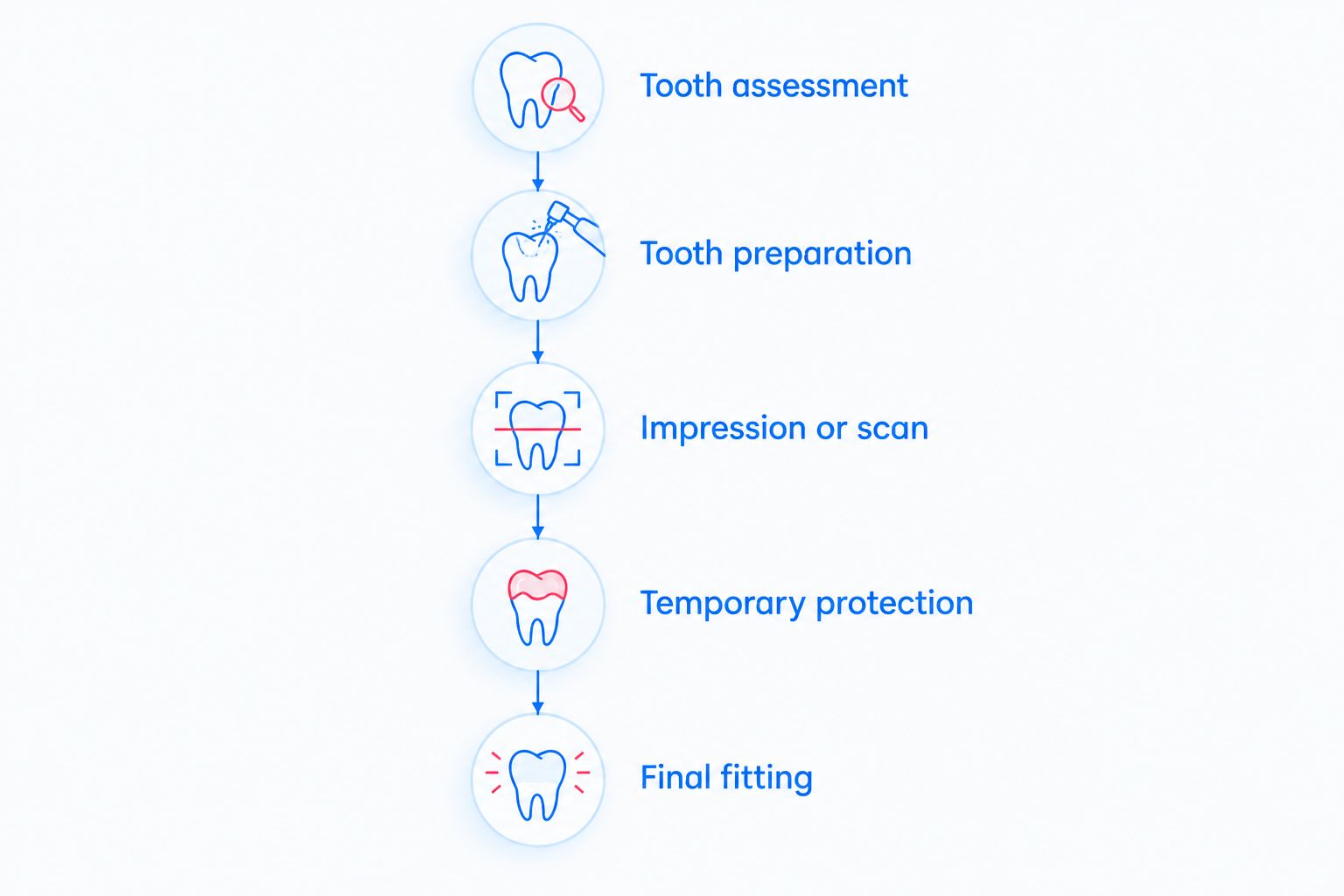
The steps explain why a crown visit is more than placing a cover over your tooth. Some patients also need treatment before these steps begin.
- Tooth assessment. Your dentist examines the tooth and reviews relevant imaging. The goal is to determine whether a crown is appropriate and whether another problem needs treatment first.
- Tooth preparation. Your dentist numbs the area as needed and reshapes the tooth to create room for the crown. A damaged tooth sometimes needs rebuilding before the crown can be fitted.
- Impression or scan. Your dentist records the prepared tooth and the way your teeth meet. This information helps guide the crown’s shape and fit.
- Temporary protection. For a traditional crown, your dentist usually places a temporary restoration while the laboratory makes the permanent one. You receive instructions for eating and cleaning around it.
- Final fitting. Your dentist checks the finished crown, including its edges and your bite. Placement follows once the fit is acceptable.
If you feel nervous, tell the dentist before preparation begins. Ask how to signal for a pause and what sensations to expect; understanding the sequence gives you a clearer picture of the visit.
Why dental crown treatment time varies
Your tooth’s condition matters more than a general appointment estimate. These factors help explain why another person’s crown schedule is not necessarily yours:
- Decay or a broken tooth: Removing decay or rebuilding missing tooth structure adds work before the crown is ready to fit.
- Root canal treatment: A tooth that needs root canal treatment has an additional treatment stage. Not every tooth receiving a crown needs a root canal.
- Gum health: Inflamed or bleeding gums can interfere with recording the tooth accurately and assessing the crown’s edges.
- Crown-making process: A laboratory-made crown includes production time between visits; an in-office crown follows a different schedule.
- Fit and bite adjustments: A crown that needs further adjustment or remaking changes the completion date.
Ask for a schedule based on your tooth, not just the usual crown timeline. If your tooth broke around an existing filling, the guide to a crown versus a filling after a tooth breaks explains the treatment decision that comes before scheduling.
How long will I be in the dental chair?
The 2-appointment estimate describes the number of visits, not the length of either visit. Preparation usually involves more steps than fitting a finished crown, but the time reserved depends on the work needed and the office’s process.
Ask for the planned appointment length when you book. Also ask whether that time includes an examination, imaging, rebuilding the tooth, or other treatment.
For your 2026 appointment, describe any practical limits upfront: a work shift, school pickup, transportation arrangements, or difficulty keeping your mouth open. That helps the office discuss scheduling without rushing the clinical work.
Can I eat and work after a crown appointment?
After a crown appointment, follow your dentist’s instructions about eating, numbness, and the restoration placed that day. Avoid chewing while the area remains numb so you do not accidentally bite your cheek or tongue.
With a temporary crown, avoid sticky foods that pull on it and hard foods that put excessive pressure on it. Clean the area as instructed rather than leaving it untouched.
Ask separately about returning to work and driving, especially if your visit involves anything beyond local numbing. Instructions after sedation differ from instructions after local anesthetic alone; do not assume they are the same.
What should I ask before booking a crown in 2026?
A short scheduling conversation helps you understand what is planned and what remains undecided. You do not need dental terminology to get useful answers.
Ask these questions:
- Is this a laboratory-made crown or an in-office crown?
- What appointment length should I reserve for preparation and fitting?
- Does my tooth need any treatment before preparation?
- Will I have a temporary crown, and how should I care for it?
- How will you confirm that the permanent crown is ready?
- What should I do if the temporary crown loosens?
Also ask for the proposed treatment and payment information before you commit. If you use dental insurance, check benefits, exclusions, and your expected responsibility; having coverage does not automatically mean the entire treatment is covered.
Dentistry of Tavares offers general and restorative dental care, including crowns. Bring your questions about comfort, timing, and payment arrangements to the appointment rather than assuming the details from a general guide.
Does needing a root canal make a crown take longer?
The usual 2-appointment crown process does not include separate root canal treatment. When a root canal is needed, your dentist will coordinate treatment of the tooth’s interior with rebuilding and protecting the tooth afterward.
A crown recommendation alone does not mean you need a root canal. Ask your dentist which treatment is necessary and how that changes the order of appointments.
Is a same-day crown better than a traditional crown?
A 1-appointment same-day crown reduces repeat visits, but fewer visits do not make it the better choice for every tooth. Suitability depends on the tooth, the planned restoration, and the available crown-making process.
A traditional crown includes a waiting period and temporary protection. Choose the route your dentist recommends for the clinical situation, with convenience as part of the discussion rather than the only consideration.
What if my temporary crown comes off before the next visit?
The 2–3-week laboratory interval is not a reason to wait with a loose or missing temporary crown. Contact your dental office for instructions and keep the crown if you still have it.
Do not use household glue to put it back. Ask how to protect the tooth and whether an earlier visit is needed; same-day help depends on clinical needs and appointment availability.
FAQ
How long does a dental crown procedure take from start to finish?
A traditional dental crown usually takes 2 appointments with a laboratory wait of about 2–3 weeks between them. Additional treatment before preparation or a crown that needs remaking changes that schedule.
Can I get a permanent dental crown in one day?
A permanent crown can be prepared and placed in 1 appointment when the tooth is suitable and the practice has the necessary in-office equipment. Confirm the treatment process with your dentist rather than assuming same-day crowns are offered.
Does getting a crown hurt?
Your dentist uses local anesthetic as needed to numb the tooth during preparation. Pressure, temporary sensitivity, and the experience of receiving the numbing injection are different sensations; tell your dentist if you feel pain or need a pause.
Do I need a root canal before getting a crown?
Not every tooth receiving a crown needs a root canal. Your dentist checks the tooth to determine whether its interior needs treatment before the crown is placed.
How long do I wear a temporary crown?
You usually wear a temporary crown until the permanent crown is ready and fitted; Cleveland Clinic describes a laboratory wait of about 2–3 weeks. Your dental office should confirm the fitting date and give you care instructions.
Can I go back to work after my crown appointment?
Your return-to-work instructions depend on the treatment and any medication or sedation used. Ask before the appointment, and follow separate instructions about driving if sedation is involved.
What should I do if my new crown feels too high?
Contact your dentist if the new crown feels as though it touches before your other teeth when you bite. The bite needs assessment rather than an assumption that you should simply get used to it.
One last thing
A crown appointment is not finished just because the crown is attached: the bite matters too. Before you leave, tell the dentist if one spot feels higher than the others or closing your teeth feels uneven.
If that feeling becomes clear after the numbness wears off, contact the office. A useful 2026 planning habit is to leave room for follow-up before an important trip instead of scheduling final placement at the last possible moment.
Related guides
- Mouthguards for teeth grinding
- Understanding your dental insurance
- Sedation options for anxious dental patients
Request an appointment with Dentistry of Tavares to discuss your tooth, your comfort concerns, and the crown schedule that fits your treatment needs.