Dental Benefits for Veterans Florida: VA Rules 2026
Veterans’ dental benefits in Florida are eligibility-based programs that help former service members obtain dental care; VA health care enrollment alone does not guarantee dental coverage. This 2026 guide explains how to check VA eligibility, compare insurance and community options, and arrange care without confusing a dental appointment with authorization to pay for it.
- Dental benefits for veterans Florida eligibility depends on VA dental rules, not simply enrollment in VA health care.
- Check VA dental eligibility before buying separate coverage or arranging treatment you expect VA to cover.
- VADIP offers dental insurance to eligible VA health care enrollees and CHAMPVA beneficiaries; it is separate from VA treatment benefits.
- Dentistry of Tavares provides local general and restorative dental care; confirm payment arrangements before treatment.
Why dental benefits matter for Florida veterans
VA medical coverage and VA dental coverage have different eligibility rules. Having a VA primary care doctor does not automatically mean your cleanings, fillings, crowns, or dentures are covered. Florida residency does not remove those federal requirements.
Your next move depends on the reason you qualify: a service-connected dental condition, a qualifying disability rating, recent discharge, or another recognized eligibility category. Some categories provide broad dental care; others cover a specific condition or purpose.
For local treatment, Dentistry of Tavares offers general, cosmetic, and restorative dental care. Dentistry of Tavares is best for veterans seeking local general and restorative dental care in Tavares, rather than a VA benefits eligibility decision. Ask VA about benefits and ask the dental office about your clinical needs; neither conversation replaces the other.
How to arrange dental care as a Florida veteran
For your 2026 dental plan, separate eligibility, treatment needs, and payment. An examination identifies what your mouth needs. A benefits decision identifies what a program will cover. Written authorization establishes whether a particular outside appointment is approved.
Work through the following steps in order. If you have urgent symptoms, seek appropriate care while you clarify coverage rather than waiting for every administrative question to be settled.
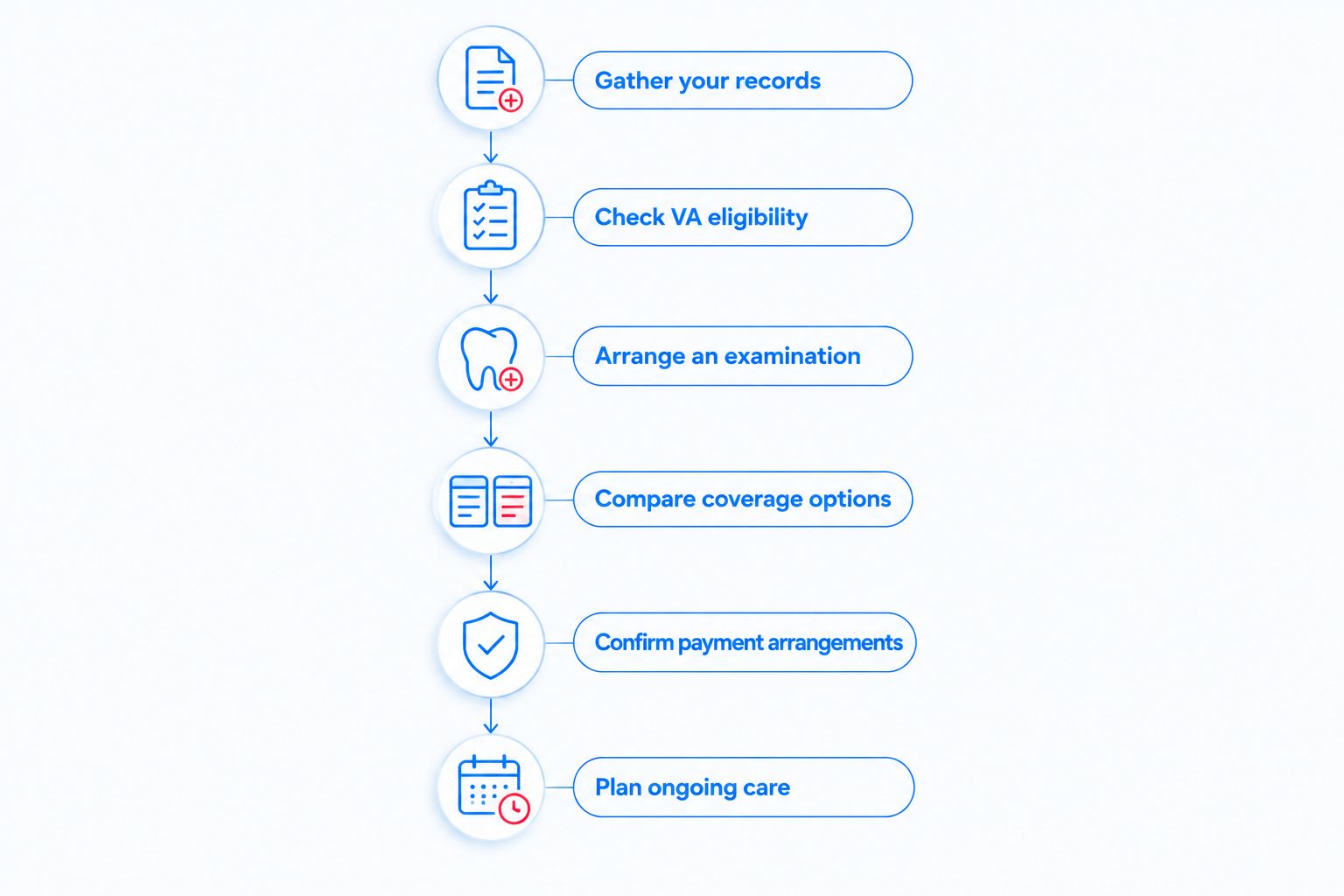
Gather your records
Start with documents you already have. Your discharge paperwork, VA disability decision, and current insurance information help you describe your situation accurately. Keep copies together so you do not have to reconstruct the same history for each conversation.
Write down your symptoms separately from your benefits questions. A broken tooth needs a clinical assessment even when you are still checking coverage. Include when the problem started, whether it affects eating or sleeping, and what treatment you have already received.
If you feel nervous about dental visits, add that to your notes. You can ask the office to explain each part of the examination, agree on a signal for a pause, and discuss comfort options before treatment begins.
- Locate your DD214 or other discharge documents.
- Gather VA rating decisions and dental-related records.
- List medications, allergies, and relevant medical conditions.
- Bring current dental insurance information, if applicable.
- Write down symptoms and questions about comfort.
Check VA eligibility
Contact your VA health care facility and request a dental eligibility review. Ask which eligibility class applies and what care that class permits. A general statement that you receive VA benefits is not enough to establish dental coverage.
The VA’s published dental eligibility rules distinguish several routes. Veterans with a compensable service-connected dental disability can qualify for needed dental care. Veterans with a 100% service-connected disability rating, or qualifying individual unemployability, can also qualify for needed dental care; temporary total ratings do not establish the same eligibility.
Other routes include service-related dental trauma, certain former prisoners of war, and dental care connected to qualifying rehabilitation or medical treatment. These categories have their own limits.
The VA’s published rules also describe one-time dental care for certain recently discharged veterans: generally, apply within 180 days after discharge, with 90 days of qualifying active service and additional discharge and dental-examination requirements. These figures are eligibility rules, not appointment guarantees.
For a 2026 application, ask VA to confirm the current requirements for your circumstances rather than treating a rating or discharge date as the entire decision.
- Ask for your applicable dental eligibility class.
- Confirm whether coverage is ongoing or limited.
- Explain any documented service-related dental injury.
- Ask promptly about deadlines after discharge.
- Request an explanation if eligibility is denied.
Arrange an examination
An examination turns a general concern into a treatment plan. The dentist can identify which problems need attention first and explain the choices for repairing a tooth, treating gums, or replacing missing teeth. Benefits paperwork cannot establish that diagnosis.
If VA confirms eligibility, ask how to arrange the examination through VA. If you are considering a local practice while checking benefits, contact the office yourself and clarify payment before booking. Do not assume a private appointment becomes covered because you have a VA identification card.
Dentistry of Tavares offers preventive care, crowns and bridges, and oral surgery among its services. Discuss your symptoms and goals without assuming a particular procedure is necessary. For payment terminology, the guide to understanding your dental insurance can help you prepare questions.
You do not need to arrive knowing the right treatment. Your job is to describe the problem; the dentist’s job is to explain the findings and reasonable options.
- Ask what the examination will include.
- Describe pain, swelling, chewing problems, or broken teeth.
- Request a clear explanation of recommended treatment.
- Discuss anxiety and ask how pauses will work.
- Ask which concerns need attention first.
Compare coverage options
If you do not qualify for VA dental treatment, check whether you qualify for the VA Dental Insurance Program, known as VADIP. VA describes VADIP as optional dental insurance for eligible veterans enrolled in VA health care and eligible CHAMPVA beneficiaries. It is separate from VA-provided dental treatment.
VADIP’s participating insurers are Delta Dental and MetLife. Compare the current plan documents rather than choosing by insurer name alone. Covered services, waiting periods, benefit limits, and participating dentists determine whether a plan fits the treatment you need.
Also review any existing employer, retiree, or other dental coverage. Buying another policy without checking your current benefits adds another set of rules to manage.
For your 2026 comparison, start with the proposed treatment, then ask how each option handles it. Community clinics and dental teaching programs are another route to investigate, but each sets its own patient eligibility and appointment process.
- Check VADIP eligibility through VA’s official information.
- Review the actual policy documents before enrolling.
- Confirm whether your intended dentist participates.
- Check waiting periods and annual benefit limits.
- Ask community programs about eligibility and appointments.
Confirm payment arrangements
A dentist accepting an insurance plan is not the same as VA authorizing community care. If you expect VA to cover treatment outside a VA facility, ask VA whether a referral and authorization are required for your appointment. Confirm the approved provider and scope of care before treatment.
For insurance-funded care, ask the office to verify benefits and explain your expected responsibility. An estimate is useful for planning, but it is not a guarantee that an insurer will pay every submitted claim.
Keep the clinical plan and payment plan together. If a dentist finds another problem during treatment, ask whether the change needs a new estimate or additional authorization. This is especially important when an approved examination leads to a recommendation for further care.
You can ask about insurance support or payment arrangements without assuming the practice offers a particular program. Get the terms directly from the office before making a decision.
- Confirm the authorized provider, when authorization applies.
- Ask which procedures the authorization includes.
- Check whether approval has an expiration date.
- Request a written treatment and payment estimate.
- Clarify who submits claims and handles follow-up questions.
Plan ongoing care
Once the immediate problem is addressed, ask your dentist to set a follow-up schedule based on your teeth, gums, medical history, and treatment. A one-time benefits approval is not a long-term prevention plan, and not every patient needs the same appointment schedule.
Ask for practical instructions you can follow at home. Brushing with fluoride toothpaste and cleaning between teeth support oral health, but the technique and tools should suit your mouth. Tell the dentist if arthritis, limited hand movement, dry mouth, or another issue makes daily care difficult.
Review your coverage again before new treatment. An authorization for one episode of care does not establish payment for unrelated future procedures. Likewise, insurance benefits can change when a plan renews.
For the rest of 2026, keep a simple record of completed treatment, upcoming visits, and any benefits questions that remain open.
- Request personalized brushing and between-teeth cleaning advice.
- Discuss dry mouth and medication-related concerns.
- Follow the dentist’s recommended review schedule.
- Keep treatment records and authorization documents.
- Recheck coverage before additional procedures.
Compare dental care routes for Florida veterans
There is no single route that fits every veteran. Choose by eligibility and treatment need, not by the word “veteran” in a program name. A benefits program, an insurance policy, and a dental office perform different jobs.
| Option | Best for | Main advantage | Key limitation |
|---|---|---|---|
| VA dental treatment | Veterans who meet a VA dental eligibility category | Provides care within the applicable benefit category | VA health care enrollment alone does not establish dental eligibility |
| VA-authorized community dental care | Eligible veterans whom VA approves for outside care | Allows approved care outside a VA facility | Requires the applicable VA referral and authorization process |
| VADIP | Eligible VA health care enrollees and CHAMPVA beneficiaries seeking dental insurance | Provides a separate insurance route | Policy exclusions, waiting periods, networks, and benefit limits apply |
| Existing dental insurance | Veterans with employer, retiree, or other dental coverage | Uses coverage you already have | Your specific policy determines covered services and patient responsibility |
| Community clinics or dental teaching programs | Patients seeking another care route | Expands the places you can ask about treatment | Eligibility, services, and appointment processes vary |
| Private dental care | Veterans arranging treatment directly with a local dentist | Lets you discuss needs directly with the practice | Payment and coverage must be arranged separately; VA payment is not automatic |
When comparing routes in 2026, ask the same question each time: does this option address the treatment recommended for me? Broad descriptions such as “dental coverage” do not tell you whether a particular crown, bridge, or other procedure is included.
Common mistakes Florida veterans make
Assuming a VA medical card covers dental treatment
VA dental eligibility uses separate rules. Ask for a dental eligibility determination rather than relying on your medical enrollment status. If you qualify, find out the scope of care as well as the category.
Waiting to check post-discharge requirements
Some one-time benefits have application deadlines and additional conditions. Start the eligibility conversation promptly after discharge, even if your mouth feels comfortable. Ask VA which documents establish your eligibility and when you must apply.
Booking outside care before confirming authorization
A private dentist’s willingness to see you does not establish VA payment. Confirm the referral, authorization, provider, and covered services first when you expect VA to fund community care.
Buying insurance without checking the treatment details
A policy that covers preventive visits does not necessarily cover your planned restorative work on the same terms. Check waiting periods, exclusions, and benefit limits against the dentist’s proposed treatment before enrolling.
FAQ
Do all veterans in Florida get free dental care through VA?
No. VA dental treatment depends on a qualifying eligibility category, and enrollment in VA health care alone does not establish dental coverage. Ask VA to determine your category and explain its scope.
Does a 100% VA disability rating qualify me for dental care?
A 100% service-connected disability rating can qualify you for needed VA dental care under VA’s published eligibility rules. Qualifying individual unemployability is another route; temporary total ratings do not establish the same eligibility.
Can I use VA dental benefits at any Florida dentist?
No. If you expect VA to pay for outside dental care, confirm the applicable referral and authorization requirements with VA before treatment. A private appointment or VA identification card does not establish payment.
What is VADIP, and who can enroll?
VADIP is the VA Dental Insurance Program, a separate dental insurance option for eligible veterans enrolled in VA health care and eligible CHAMPVA beneficiaries. Review the current insurer documents for covered services, networks, waiting periods, and benefit limits.
How soon should I apply for dental benefits after leaving the military?
Ask VA about dental eligibility promptly after discharge. Certain one-time benefits generally require an application within 180 days after discharge, qualifying service, and additional conditions; VA must determine whether those requirements apply to you.
Does Dentistry of Tavares provide VA-authorized dental care?
Confirm VA authorization and provider arrangements directly with VA and the practice before booking care you expect VA to cover. Dentistry of Tavares provides general, cosmetic, and restorative dental services, but that does not establish VA participation or payment.
What should I do if I have swelling or trouble swallowing?
Trouble breathing or swallowing, or significant swelling spreading into the face or neck, requires urgent medical assessment. Seek emergency help rather than waiting for a benefits decision; contact a dentist promptly for other urgent tooth problems.
One last thing
The most useful benefits question is not simply whether you have dental coverage. Ask: “Is this treatment, with this provider, approved under my benefits?” That question connects the eligibility decision to the actual appointment and avoids treating approval for one service as approval for everything.
Related guides
- Same-day dental emergency appointments in Tavares
- Dental care for seniors
- Dental bridge versus implant for one missing tooth
If you need local dental care, request an appointment with Dentistry of Tavares. Share your symptoms, comfort concerns, and coverage questions so you can discuss your next step clearly.