Can a chipped tooth be fixed without a crown?
Yes, a chipped tooth can often be fixed without a crown when enough healthy tooth remains. A dentist can smooth a tiny chip, rebuild a small missing piece with tooth-colored bonding, or repair suitable damage with a filling. The important caveat: a small-looking chip can hide a deeper crack, so the right repair depends on an examination—not appearance alone.
- Can a chipped tooth be fixed without a crown? Yes, when enough healthy tooth remains to support the repair.
- Bonding and fillings repair suitable chips; crowns protect teeth that need more extensive support.
- Pain when biting, swelling, or a loose tooth calls for prompt dental attention.
- Dentistry of Tavares offers general and cosmetic dental care for local patients seeking a chipped-tooth assessment.
Why this matters
The goal is to preserve healthy tooth while making the repair strong enough for your bite. A crown is not automatically necessary, but avoiding one is not always the safest choice either.
If the chipped tooth already has a large filling, the decision changes. This guide to a crown versus filling after a filled tooth breaks explains that particular situation.
For your 2026 dental visit, focus on what remains beneath the chip. A repair needs a sound foundation, whether the damage affects a visible front tooth or a back tooth that handles chewing pressure.
Can a chipped tooth be fixed without a crown?
Yes. Small chips limited to the outer tooth surface often have crown-free repair options. More extensive breaks need an assessment of the remaining tooth, any decay, the bite, and whether the damage reaches the tooth's inner tissue.
The comparison below explains common approaches. These are treatment categories, not a diagnosis or a list of services confirmed for a particular practice.
| Approach | Best for | Main benefit | Main limitation |
|---|---|---|---|
| Smoothing or polishing | A tiny, shallow enamel chip | Removes a rough edge without adding a restoration | Does not replace missing tooth structure |
| Tooth-colored bonding | A small chip with enough healthy supporting tooth | Rebuilds the missing shape while preserving tooth | Can chip or stain and needs maintenance |
| Filling | A localized break or cavity with adequate remaining structure | Restores the damaged area without covering the whole tooth | Does not adequately protect every weakened tooth |
| Veneer | Selected front-tooth chips with a broader appearance concern | Changes the visible front surface | Usually involves enamel preparation and is not suitable for every bite |
| Onlay | Selected larger chewing-surface defects | Covers damaged areas while leaving some tooth uncovered | Requires suitable remaining structure and careful planning |
| Crown | Extensive damage or a tooth needing broader protection | Covers the prepared tooth to support and protect it | Requires more tooth preparation than a small repair |
Choose the least extensive treatment that adequately protects the tooth—not simply the smallest treatment. Your dentist should explain both what a repair solves and what it leaves unprotected.
Smoothing: for a tiny, shallow chip
A dentist can sometimes smooth a very small chip when the tooth has lost only a little enamel. This approach addresses a rough or uneven edge rather than rebuilding the tooth.
The benefit is simplicity. The limitation is that polishing removes a small amount of tooth surface, so it cannot restore a noticeably missing corner or treat a deeper fracture.
Best for: a minor enamel irregularity that does not need its shape rebuilt. Do not use a nail file or another household tool to smooth your tooth yourself.
Bonding: for a small missing piece
Bonding uses tooth-colored resin to replace a chipped area. The dentist shapes the material to match the tooth and checks how the repair meets the opposing teeth.
This often suits a small front-tooth chip because it can restore shape without covering the whole tooth. Bonding still has limits: a repair placed under heavy biting pressure can break, and the material can discolor over time.
Best for: a small chip with enough sound tooth to hold the repair. Ask whether your bite puts pressure directly on the repaired edge and what habits you should change afterward.
Fillings and onlays: for selected chewing-surface damage
A filling repairs a localized damaged area. An onlay covers more of the chewing surface and can protect selected weakened parts of a tooth without covering it completely.
For your 2026 treatment discussion, ask how much healthy tooth remains around the damage. A small filling can be appropriate for a contained defect, while a larger break requires a different level of support.
Best for: repairable damage in a tooth with sufficient remaining structure. Neither treatment is automatically a substitute for a crown; a crack or heavily weakened tooth can make a smaller repair unsuitable.
Veneers: for selected front-tooth concerns
A veneer covers the visible front surface of a tooth. It can address a chip alongside concerns about shape or appearance, but it is not the default treatment for every chipped front tooth.
Veneers generally involve preparation of the tooth and need ongoing care. They also do not provide the same coverage as a crown when a tooth needs broader structural protection.
Best for: selected front-tooth damage with a wider cosmetic goal. If your only concern is a small missing corner, ask whether bonding would address it with less tooth preparation.
When does a chipped tooth need a crown?
A crown becomes more relevant when substantial tooth structure is missing, a large existing filling leaves the tooth weak, or the remaining tooth needs protection against chewing forces. Some cracks also affect the treatment choice.
A crown covers the prepared tooth, but it cannot make every damaged tooth repairable. Your dentist must first establish whether the tooth can be restored and whether its inner tissue needs treatment.
Best for: a restorable tooth that needs broader protection than a localized repair provides. The trade-off is more tooth preparation, so ask why full coverage is necessary for your particular tooth.
Why chipped-tooth treatment varies
The right repair depends on more than the size of the missing piece. During your 2026 examination, these factors help explain why two similar-looking chips can need different treatments:
- Chip depth: damage limited to enamel differs from damage that exposes deeper tooth layers.
- Remaining tooth: a repair needs enough sound structure to support it.
- Existing fillings: a large restoration can leave less natural tooth around a new break.
- Crack extent: a fracture can extend beyond the area you can see.
- Bite pressure: tooth position, grinding, and the way teeth meet affect stress on a repair.
- Inner-tissue health: injury or infection inside the tooth can require treatment beyond replacing the missing piece.
Tell your dentist whether the tooth broke while eating, after an impact, or without an obvious cause. Also mention previous repairs and any pain when biting or releasing your bite.
What should you do before your appointment?
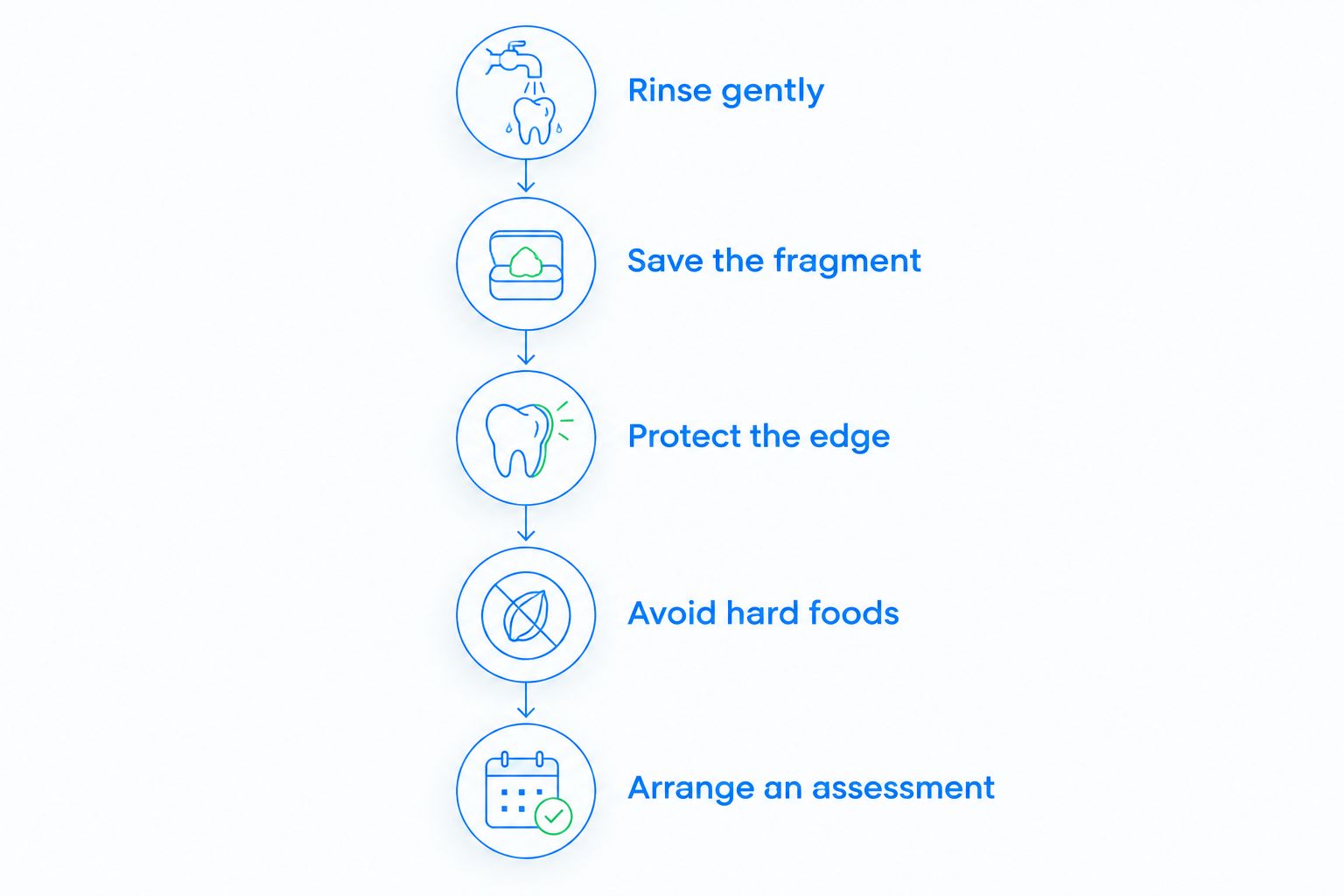
Protect the tooth and arrange an assessment rather than trying to repair it at home. A sharp edge, sensitivity, or a change in your bite gives your dentist useful information about the injury.
- Rinse gently. Use water to clear the area without scrubbing the damaged tooth.
- Save the fragment. If you find the broken piece, keep it moist in milk or saliva and bring it with you. A dentist can assess whether reattachment is possible.
- Protect the edge. Dental wax can temporarily cover a sharp edge that rubs your tongue or cheek.
- Avoid hard foods. Do not test the tooth by biting down on something firm, and avoid chewing directly on the damaged area.
- Arrange an assessment. Describe the injury, your symptoms, and whether the tooth feels loose.
These steps protect the area temporarily; they do not replace treatment. Never use household glue or attempt to attach the fragment yourself.
Is a chipped tooth a dental emergency?
A chipped tooth needs prompt attention when you have significant pain, swelling, bleeding that does not stop, or a loose tooth after an injury. A small painless chip still needs a dental assessment, but it does not automatically require emergency treatment.
Seek emergency medical care for trouble breathing or swallowing, or a serious facial injury. Those symptoms need care beyond a routine dental appointment.
If you need help locally in 2026, read about same-day dental emergency appointments in Tavares. Same-day care depends on what is possible when you contact the practice; it is not guaranteed.
Does a chipped tooth always need a root canal?
No, a chipped tooth does not always need a root canal. Many shallow chips affect only the outer tooth layers and can be repaired without treating the tissue inside.
A root canal treats damaged or infected inner tissue; it does not simply replace the missing corner. If your dentist recommends it, ask what findings show that the inner tissue needs treatment and what restoration will protect the tooth afterward.
Can you leave a small chipped tooth alone?
A small chipped tooth should be examined before you decide to leave it untreated. Lack of pain does not establish that the damage is limited to enamel.
After assessing the tooth, your dentist can explain whether smoothing, repairing, or monitoring it is appropriate. Avoid treating a painless chip as proof that the tooth is safe under normal chewing pressure.
What should you ask at your dental visit?
You do not need to arrive knowing which restoration to choose. Dentistry of Tavares is a local general and cosmetic dental practice for patients who want a chipped-tooth assessment and a discussion of their care.
Dentistry of Tavares is a fit for Tavares patients seeking general and cosmetic dental care. Bring your questions, especially if you feel nervous about treatment.
For a clear 2026 treatment discussion, ask:
- Is the damage limited to the outer tooth, or does it extend deeper?
- What makes bonding, a filling, or a crown appropriate for this tooth?
- How much healthy tooth would each option preserve?
- What are the limitations and maintenance needs of the proposed repair?
- Can we agree on a signal to pause if I feel uncomfortable?
- What payment options and insurance benefits should I check before treatment?
Ask for a written treatment estimate and confirm coverage with your insurer. Do not assume that an appearance-related repair and a repair needed for tooth function receive the same coverage.
Request a dental appointment
Discuss your chipped tooth, symptoms, and questions about repair options.
How do you care for a repaired chipped tooth?
A repair needs the same daily care as the rest of your teeth. Brush with fluoride toothpaste for 2 minutes per session, 2 times per day, and clean between your teeth 1 time per day.
Avoid biting fingernails, chewing ice, or using teeth to open packaging. These habits put unnecessary pressure on both natural teeth and restorations.
If you grind your teeth, ask whether a professionally assessed mouthguard is appropriate. Report a repair that feels high when you bite, develops a sharp edge, or becomes painful; do not keep testing it by chewing harder.
FAQ
Can a chipped tooth be fixed without a crown?
Yes, a chipped tooth can often be fixed without a crown when enough healthy tooth remains. Smoothing, bonding, fillings, and selected partial-coverage restorations address different types of damage; an examination determines which fits.
Is bonding better than a crown for a chipped front tooth?
Bonding can be the less extensive choice for a small front-tooth chip, but it is not better for every damaged tooth. A crown is more relevant when the remaining tooth needs broader protection.
Can a dentist fix a chip in one appointment?
Some small chips can be smoothed or bonded during one appointment. The examination, symptoms, treatment needs, and scheduling determine whether that is appropriate; same-day treatment is not guaranteed.
Does a painless chipped tooth still need checking?
Yes, a painless chipped tooth still needs a dental assessment. Pain alone does not show how deep the damage extends or whether a crack is present.
Will my insurance cover a chipped-tooth repair?
Coverage depends on your plan, the treatment, and the reason for the repair. Ask for a written estimate and confirm benefits with your insurer before treatment.
What should I do if my chipped tooth is sharp?
You can temporarily cover a sharp edge with dental wax while arranging an assessment. Do not file the tooth or use household glue.
Where can I discuss a chipped tooth in Tavares?
Dentistry of Tavares offers general and cosmetic dental care for local patients. Request an appointment to have the tooth assessed and discuss suitable next steps.
One last thing
A chip's visible size does not tell you how much protection the tooth needs. Ask your dentist to explain the remaining tooth structure and bite pressure before choosing a repair.
The best question is not simply, “Can I avoid a crown?” It is, “What is the least extensive repair that adequately protects this tooth?”
Related guides
- How long does a dental crown procedure take?
- Mouthguards for teeth grinding
- Understanding your dental insurance
Request an appointment to discuss your chipped tooth and find out which repair fits your needs.