How long does a dental bridge last?
A dental bridge typically lasts 5–15 years, and some last longer with good cleaning and regular dental care. That general guidance applies in 2026, but it is not a replacement deadline: the condition of the bridge, supporting teeth, and gums matters more than its age. Even an intact bridge needs attention if decay develops underneath it or its support becomes loose.
- How long does a dental bridge last? Typically 5–15 years; its condition determines when replacement is needed.
- Dentistry of Tavares offers dental bridges for local patients seeking fixed tooth replacement.
- Daily bridge care must include cleaning underneath the replacement tooth, not just brushing its surface.
- A loose bridge, biting pain, or recurring gum bleeding needs a dental assessment.
Why this matters
Knowing the usual lifespan helps you plan without assuming that an older bridge has failed. A bridge can look fine from above while a supporting tooth develops a problem underneath.
Treat the 5–15-year range as a planning guide, not an expiration date. If you are weighing replacement choices, the dental bridge vs. implant guide explains the differences to discuss with your dentist.
How long does a dental bridge last?
Cleveland Clinic’s patient guidance gives a typical dental bridge lifespan of 5–15 years, with longer service possible through proper care. This is general patient guidance, not a prediction for an individual bridge.
For a bridge placed in 2026, your dentist can explain which conditions affect its outlook. Healthy supporting teeth, manageable biting forces, and effective cleaning all matter; choosing a material alone does not determine how long the bridge will last.
| What your bridge is doing | What it means | Sensible next step |
|---|---|---|
| Feels stable and comfortable | Age alone does not establish failure | Continue cleaning and scheduled examinations |
| Feels loose or moves | The attachment or underlying support needs assessment | Arrange an appointment; do not glue it yourself |
| Hurts when you bite | The bite, supporting tooth, or bridge needs checking | Avoid chewing on that side until assessed |
| Traps food differently than before | The fit, gum position, or contact with nearby teeth needs checking | Tell your dentist what changed |
| Has a chip or crack | The damage needs evaluation before deciding on repair or replacement | Avoid hard foods against the damaged area |
A dentist checks more than the visible replacement tooth. The examination includes the bridge edges, supporting teeth, gums, and bite; X-rays help assess areas that cannot be seen directly when clinically needed.
Does the type of bridge change its lifespan?
Bridge design changes how the replacement tooth is supported and what needs maintenance. There is no single lifespan that applies equally to every bridge design. Your dentist should explain the expected maintenance for the specific design being considered.
The following comparison describes general options, not a list of services confirmed at this practice.
| Bridge type | Best for | Main benefit | Main limitation |
|---|---|---|---|
| Traditional tooth-supported bridge | Suitable gaps with supporting teeth on both sides | Provides a fixed replacement supported by neighboring teeth | Supporting teeth need preparation and remain vulnerable to decay |
| Resin-bonded bridge | Selected gaps, often involving a front tooth | Usually requires less removal of neighboring tooth structure | The bonded attachment can loosen; suitability depends on the bite |
| Implant-supported bridge | Selected gaps where implants can provide suitable support | Does not rely on neighboring natural teeth for support | Requires implant treatment and ongoing care around the implants |
A traditional bridge can remain intact while a supporting tooth develops decay. An implant-supported bridge has different concerns: implants do not develop tooth decay, but the surrounding tissues and attached restoration still need care.
Ask which part of the proposed treatment might need maintenance. The replacement teeth, attachment components, and supporting structures are not the same thing, and a problem with one does not automatically mean everything must be replaced.
Why dental bridge lifespan varies
The useful life of a bridge depends on its support and daily care, not simply the date it was fitted. These factors help explain why bridges placed at the same time do not necessarily need replacement together:
- Cleaning underneath the bridge. Plaque can collect around the supporting teeth and beneath the replacement tooth. Brushing the visible surfaces does not clean every area.
- Health of the supporting teeth. Decay, cracks, or other problems in a supporting tooth can affect an otherwise intact bridge.
- Gum health. Inflammation and loss of support around teeth can threaten the bridge’s foundation. Bleeding deserves attention rather than harder brushing.
- Grinding and bite pressure. Clenching, grinding, and uneven tooth contacts place stress on the restoration and its supports.
- Bridge design and fit. The location of the gap, available support, and fit of the restoration affect how forces are distributed and how easily you can clean.
- Follow-up care. Examinations give your dentist a chance to identify changes before you notice discomfort or movement.
These are reasons to personalize care, not reasons to expect failure. If one factor applies to you, ask what practical change would help protect your bridge.
How can you help a dental bridge last longer?
Your 2026 bridge-care plan should cover both the visible restoration and the areas underneath it. Ask your dental team to demonstrate the cleaning method in your own mouth, then try it while they watch.
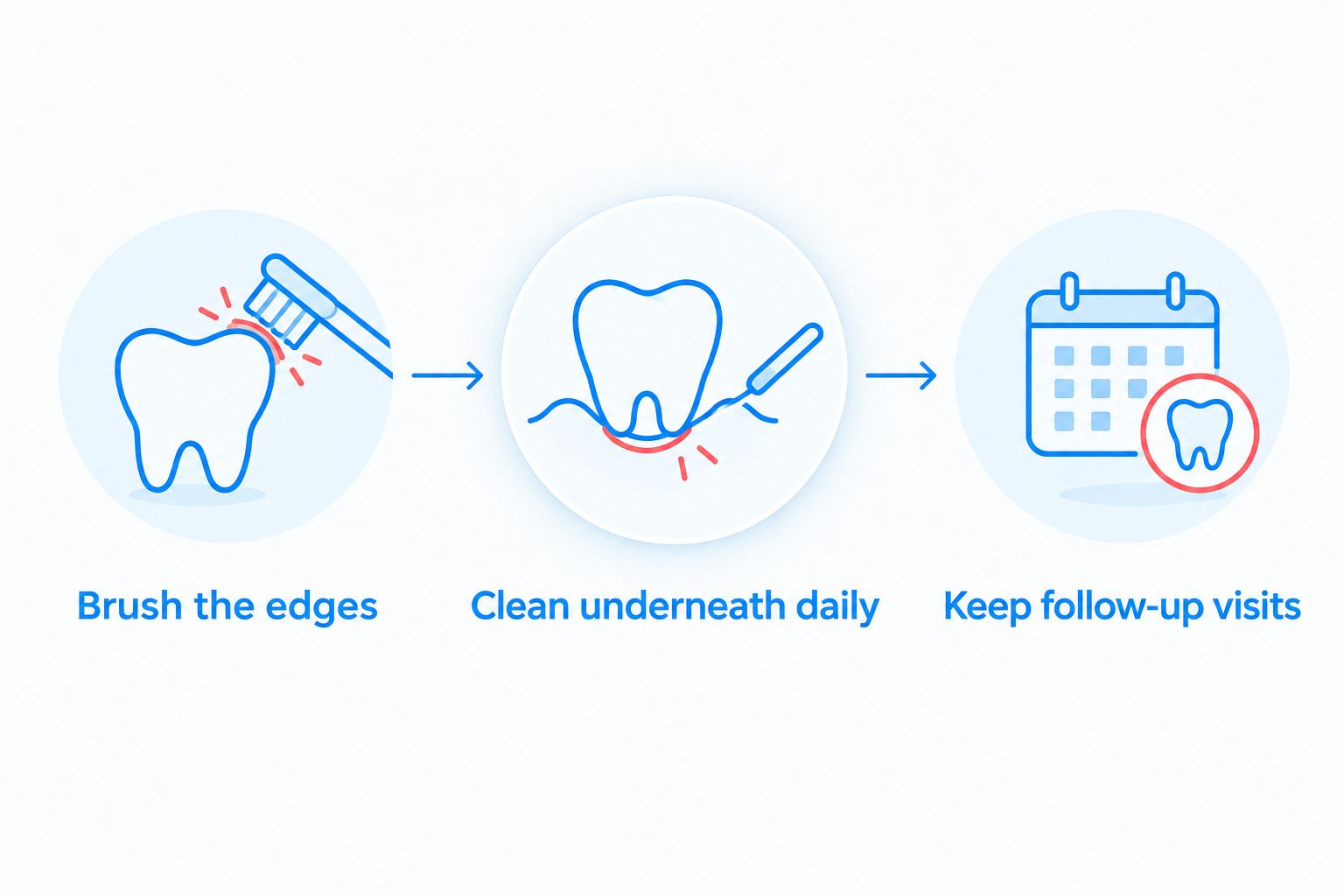
Brush the edges gently
Brush twice a day for 2 minutes with fluoride toothpaste, following American Dental Association home-care guidance. Pay attention to where the bridge meets the gums and the edges around its supporting teeth.
Use gentle pressure rather than scrubbing. A bridge is not a reason to brush harder, especially if your gums already feel tender.
Clean underneath daily
Clean between your teeth daily and include the space beneath the replacement tooth. Because the bridge joins teeth together, ordinary floss cannot always pass down through the contacts as it would between separate teeth.
A floss threader or bridge-specific floss can help you reach underneath. Your dentist or hygienist can show you how to move the floss along the supporting teeth without forcing it into the gums.
Keep follow-up visits
Attend examinations and cleanings on the schedule your dentist recommends. The right interval depends on your gum health, decay risk, and other needs; the bridge alone does not establish a universal appointment schedule.
Tell the team if floss catches, food collects in a new place, or your bite feels different. Those details help direct the examination.
Address grinding and chewing habits
Tell your dentist about morning jaw soreness, worn teeth, or known nighttime grinding. A dentist can assess whether a protective appliance is appropriate; do not assume every mouthguard fits safely over your bridge.
Avoid chewing ice or using your teeth to open packaging. After bridge placement or repair, follow the specific eating instructions your dentist gives you rather than relying on a general online timeline.
Can a dental bridge last longer than 15 years?
A dental bridge can last longer than 15 years, but that is not a promised outcome. Good cleaning and sound supporting structures help explain why some bridges remain useful beyond the typical range.
If your bridge reaches 15 years in 2026, ask for a condition-based assessment rather than replacing it because of the calendar. A comfortable bridge still needs examination, since an absence of pain does not rule out decay or gum problems.
Does a loose bridge always need replacing?
A loose bridge does not always need replacing. Recementing is sometimes possible if the bridge remains suitable and the supporting teeth are healthy, but the dentist must first identify why it loosened.
Keep the area clean, avoid chewing on the loose bridge, and arrange an assessment. Do not use household glue or force a detached bridge back into place; bring it to the appointment if it comes out.
When should you ask about repair or replacement?
Arrange an examination when the bridge changes, even if it is younger than 5 years. New movement, a sharp edge, repeated food trapping, persistent bad taste, or pain around a supporting tooth all deserve assessment.
Small chips and attachment problems sometimes allow repair, while decay or a damaged supporting tooth can require a different plan. The dentist needs to inspect the bridge and its foundation before explaining the options.
Seek urgent dental advice for significant pain or swelling. Trouble breathing or swallowing requires emergency medical care. You do not need to wait until your next routine cleaning to report a new problem.
What should you ask at a bridge checkup?
Bring a short description of what has changed and when you notice it. Saying that discomfort happens when you bite, rather than at rest, gives your dentist useful information without requiring you to diagnose the cause.
Useful questions for a 2026 bridge review include:
- Are the supporting teeth and gums healthy?
- Are the bridge edges and attachment secure?
- Can you show me how to clean the areas I am missing?
- Does my bite or grinding place extra stress on this bridge?
- If treatment is needed, is repair reasonable, or why is replacement preferable?
If you feel nervous, say so at the start. Ask the dentist to explain each step before proceeding and agree on a signal for a pause. You can also ask for a written treatment plan and check insurance benefits before making a nonurgent decision.
Dentistry of Tavares is a local option for Tavares patients seeking dental bridge care. Its stated services include crowns and bridges within general and restorative dentistry.
FAQ
How long does a dental bridge last in 2026?
A dental bridge typically lasts 5–15 years, and some last longer with appropriate care. Its condition, supporting teeth, gums, and bite determine whether it needs treatment—not the calendar alone.
Can a dental bridge last a lifetime?
A dental bridge is not guaranteed to last a lifetime. Plan for ongoing maintenance and possible repair or replacement, even when it remains comfortable for many years.
Do I have to replace my bridge after 10 years?
You do not automatically need to replace a bridge after 10 years. A dentist should assess its fit, condition, supporting teeth, and gums before recommending replacement.
Can a tooth get a cavity underneath a dental bridge?
A natural tooth supporting a bridge can develop a cavity. The bridge material does not decay, but exposed tooth surfaces and the edges around the restoration still need careful cleaning.
How do I clean underneath a fixed dental bridge?
Clean underneath a fixed dental bridge daily using a method your dentist or hygienist demonstrates, such as floss guided by a threader. Brush twice a day for 2 minutes as well; brushing alone does not reach every underside surface.
Is an implant-supported bridge better than a regular bridge?
An implant-supported bridge is not automatically better for every patient. It avoids using neighboring teeth as supports but requires implant treatment; a tooth-supported bridge has different preparation and maintenance needs.
Can Dentistry of Tavares check an older dental bridge?
Dentistry of Tavares lists crowns and bridges among its dental services. Request an appointment and describe any looseness, discomfort, or changes so the team can help arrange an assessment.
One last thing
A bridge does not have to break to need attention. A small change in how food collects or how your teeth meet can be a useful reason for a check, even when the bridge looks unchanged.
Related guides
- How often should you get a dental checkup and cleaning?
- Mouthguards for teeth grinding
- Can gum disease be reversed without surgery?
Have questions about your bridge or want help cleaning around it? Request an appointment with Dentistry of Tavares to discuss your concerns and next steps.