
How much does wisdom tooth removal cost in Florida in 2026?
Wisdom tooth removal costs in Florida in 2026 depend on how the tooth is positioned, how it must be removed, and the anesthesia used. The extraction fee alone does not necessarily include the examination, imaging, sedation, or follow-up care. Ask for a written, itemized estimate after an examination so you can compare the total treatment plan—not just the fee for removing a tooth.
- How much does wisdom tooth removal cost in Florida? Compare the complete treatment estimate, not the extraction fee alone.
- Dentistry of Tavares offers general dental care and oral surgery for local patients.
- A tooth’s position and the anesthesia plan help determine the treatment estimate.
- Dental insurance benefits must be checked for the proposed procedure; coverage is not a guarantee of full payment.
How much does wisdom tooth removal cost in Florida in 2026?
Your useful cost figure is the amount you would pay for the recommended treatment, including any separately billed services. A quote for an erupted tooth is not directly comparable with a quote for a tooth trapped beneath gum or bone. The treatment involved is different.
Dentistry of Tavares offers general dental care and oral surgery for local patients. When requesting an evaluation, explain whether you have pain, swelling, an existing referral, or recent dental images. Ask what the examination will include before making treatment decisions.
Use this breakdown to understand an estimate:
| Estimate component | What to clarify | Why it matters |
|---|---|---|
| Examination | Is the consultation included or billed separately? | The dentist needs to assess whether removal is appropriate. |
| Imaging | Which images are needed, and can recent images be reviewed? | Tooth position and nearby structures affect planning. |
| Extraction | Which teeth are included, and how will each be removed? | Different teeth can require different procedures. |
| Anesthesia | Does the estimate include numbing medicine, sedation, or both? | Comfort measures and their billing need separate clarification. |
| Aftercare | Are planned follow-up visits included? | You need to understand what happens after the procedure. |
An itemized estimate is more useful than a statewide average because it describes your actual treatment.
Why this matters
When you are uncomfortable or nervous, sorting out a dental estimate can feel like another task you do not need. Breaking it into parts makes the conversation easier. You can ask about treatment, comfort, insurance, and payment separately rather than trying to resolve everything at once.
Removing 1 tooth is not the same treatment plan as removing 4 teeth. Even within the same mouth, one wisdom tooth can be fully visible while another remains beneath gum or bone. Ask the dentist to explain the recommendation for each tooth individually.
A good discussion also covers alternatives. Not every wisdom tooth automatically needs removal; the decision depends on its condition, position, effect on nearby teeth, and ability to stay clean.
Erupted wisdom teeth: ask about the extraction approach
An erupted wisdom tooth has come through the gum. If the dentist can access and remove it without a surgical approach, the treatment plan differs from one requiring an incision or removal of surrounding bone. Being visible does not, by itself, establish how straightforward removal will be.
Best for: an extraction approach determined by an examination of an accessible tooth that needs removal. Its practical advantage is that it does not require the same steps as some impacted-tooth procedures. Its limitation is that roots, tooth damage, and surrounding anatomy still affect treatment.
Ask whether the estimate identifies the procedure for each tooth. If you are comparing offices, make sure both estimates describe the same proposed treatment rather than relying on the word extraction alone.
Impacted wisdom teeth: ask what the surgery involves
An impacted wisdom tooth has not fully emerged into its expected position. It can be covered by gum, bone, or both. Surgical removal can involve opening the gum, removing some surrounding bone, or dividing the tooth into smaller pieces.
Best for: a tooth requiring surgical access when removal is recommended. The benefit is access to a tooth that cannot be removed through a straightforward extraction; the trade-off is a procedure with additional surgical steps and recovery instructions.
Ask what your images show and whether the tooth's relationship to nearby structures changes the plan. If a specialist referral is recommended, clarify where the procedure will happen and which office will provide the estimate and follow-up instructions.
Removal versus monitoring: what are you paying for?
A treatment recommendation should come before a payment decision. Removing a problem tooth and monitoring a healthy tooth serve different purposes. Ask why the dentist recommends one approach and what would change that recommendation.
| Approach | Best for | Benefit | Limitation |
|---|---|---|---|
| Nonsurgical extraction | A tooth needing removal that can be accessed without surgical steps | Removes the tooth without the additional access steps used in surgery | Not appropriate for every tooth or root position |
| Surgical removal | A tooth needing removal that requires access beneath gum or bone | Allows removal when a simpler approach is unsuitable | Adds surgical steps and recovery considerations |
| Monitoring | A tooth the dentist determines does not currently require removal | Avoids an unnecessary procedure | Requires continued assessment and does not resolve an existing problem requiring treatment |
Monitoring is not the same as ignoring symptoms. Tell your dentist about new pain, swelling, food trapping, or difficulty cleaning the area. Those changes deserve assessment even if an earlier visit resulted in a recommendation to watch the tooth.
Why wisdom tooth removal estimates vary
For a 2026 estimate, focus on these treatment and billing factors:
- Tooth position: A fully erupted tooth and a tooth beneath bone can require different access.
- Procedure complexity: Root shape, tooth damage, and surrounding anatomy influence the removal plan.
- Teeth included: Check whether the estimate covers a single tooth or several teeth.
- Anesthesia plan: Local numbing and sedation are not interchangeable services; clarify what is proposed and billed.
- Diagnostic and follow-up services: Examination, imaging, and aftercare can appear separately in an estimate.
- Insurance benefits: Your plan's deductible, coverage rules, network arrangements, and remaining benefits affect your share.
These factors explain why comparing only an extraction fee can be misleading. Compare the same procedure, anesthesia plan, and included services before deciding that one estimate is lower.
How do you get a clear written estimate?
You do not need to know dental billing terminology to ask useful questions. Start with the recommended treatment and work toward your expected payment.
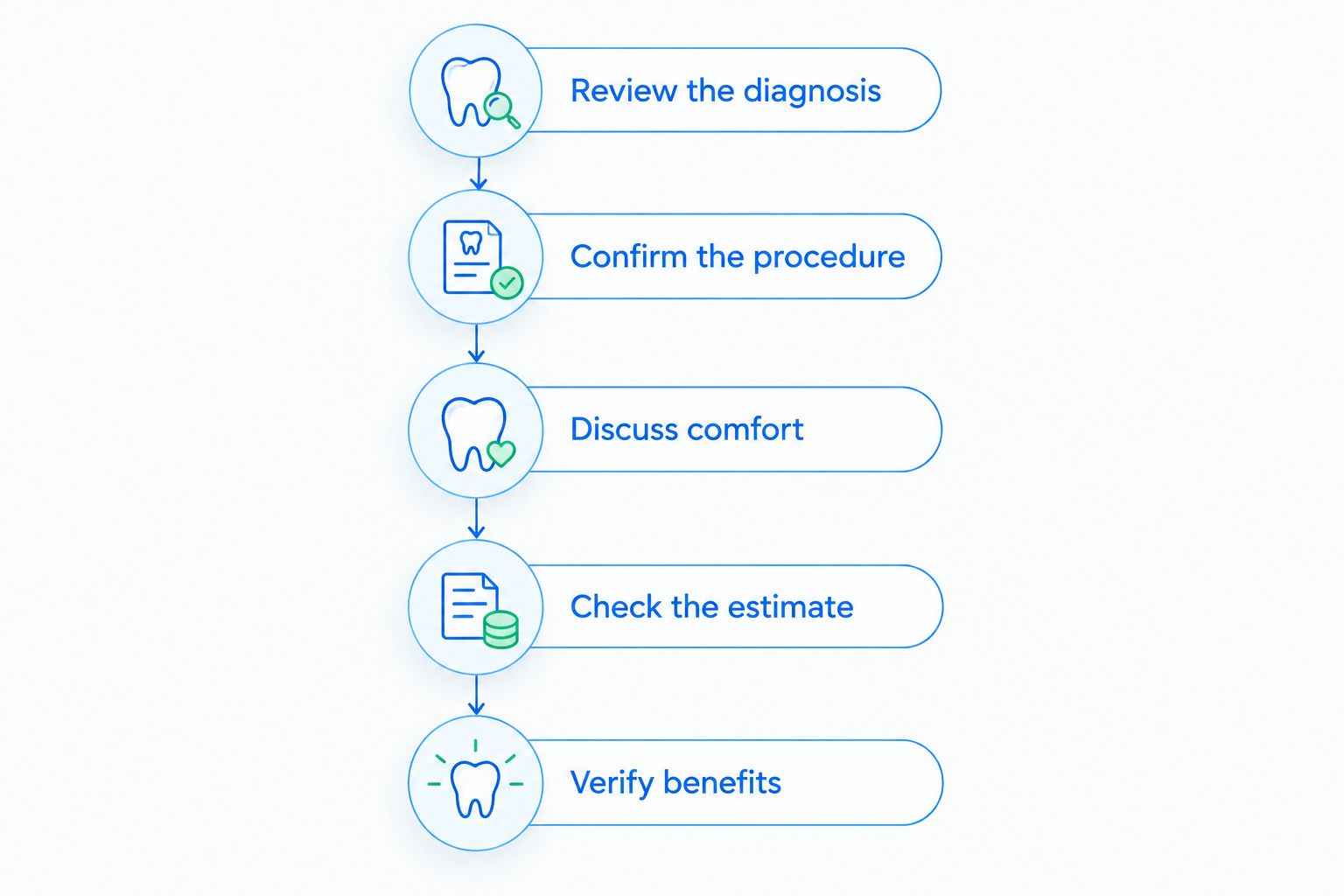
- Review the diagnosis. Ask which tooth needs treatment, why removal is recommended, and whether monitoring is an appropriate alternative. Have the dentist explain the images in everyday language.
- Confirm the procedure. Ask whether each tooth requires a nonsurgical or surgical approach. Confirm whether treatment will occur at that office or involve a referral.
- Discuss comfort. Explain any anxiety, previous difficulty getting numb, relevant medical conditions, and medicines you take. Ask what comfort options are appropriate for your situation.
- Check the estimate. Request a written list of the examination, imaging, extraction, anesthesia, and planned follow-up services. Ask which items are included and which are separate.
- Verify benefits. Ask your insurer about the proposed procedures and request an explanation of your expected responsibility. Keep the written estimate and benefit information together.
If you request 2 written estimates, bring the same available records and explain the same concerns to both offices. Differences in recommended treatment deserve an explanation, not an automatic assumption that either office is wrong. Ask what each dentist found and why the plans differ.
Keep a copy of the final plan. Before agreeing to treatment, confirm what could change the estimate and how the office would discuss that change with you.
Does dental insurance cover wisdom tooth removal in Florida?
Dental insurance can cover wisdom tooth removal, but the amount depends on your specific plan and the proposed procedure. A covered service does not mean the insurer pays the entire bill. Your deductible, remaining annual benefits, and plan rules still matter.
Use your 2026 benefit information rather than assuming last year's remaining benefits or coverage details still apply. Ask whether the treating provider participates in your network, whether the procedure requires a benefit review, and whether anesthesia is covered separately.
An insurer's pretreatment estimate helps you plan, but it is not a guarantee of payment. Final benefits depend on the claim and your eligibility when treatment occurs. Ask both the office and the insurer what information remains unconfirmed.
The guide to understanding your dental insurance explains the terms to review. Do not assume that an office accepts your particular plan simply because you recognize the insurer's name; verify the exact plan before treatment.
How can you discuss affordability without delaying needed care?
Tell the office that you need to understand your expected payment before scheduling the procedure. That is a reasonable request, not an uncomfortable one. Ask about payment arrangements, any financing offered, and whether insurance information can be reviewed before treatment.
If financing is available, read the repayment terms rather than focusing only on the payment amount. Check interest, promotional conditions, fees, and what happens if a payment is late. Financing changes how you pay; it does not change whether treatment is clinically appropriate.
Ask whether treatment can safely be staged if several teeth need attention. The dentist should explain the clinical advantages and disadvantages; splitting treatment is not automatically the safer or less expensive choice.
For urgent symptoms, request an assessment rather than waiting for every financial question to be settled. Same-day help depends on what is possible, and an examination does not promise that removal will happen that day.
Is removing all wisdom teeth at once less expensive?
Removing several wisdom teeth during one visit can combine parts of the treatment process, but it does not establish that your total payment will be lower. The answer depends on the recommended procedures, anesthesia, billing, and insurance benefits.
Ask for a comparison of the clinically appropriate plans, including what would be repeated with separate visits. Also discuss recovery, transportation, and help at home. Choose the treatment sequence with your dentist, not from a general assumption about savings.
Is sedation required for wisdom tooth removal?
Sedation is not automatically required for every wisdom tooth extraction. Local anesthesia numbs the treatment area; sedation addresses relaxation or awareness and does not replace the need to control pain.
Explain your concerns before the treatment day. If sedation is recommended, ask about preparation, transportation, monitoring, and any separate billing. Follow the treating clinician's instructions about eating, drinking, and medicines rather than using general advice to prepare yourself.
FAQ
How much does wisdom tooth removal cost in Florida with insurance?
Your payment depends on the treatment estimate and your plan’s benefits. Check the deductible, remaining annual benefits, network status, and coverage for the proposed extraction and anesthesia.
Can I get a wisdom tooth removal quote before an examination?
You can ask how an office structures its fees, but a personalized estimate depends on an examination and any necessary imaging. Ask what the initial evaluation includes and whether it is billed separately.
Is an impacted wisdom tooth the same as an erupted wisdom tooth?
No. An erupted tooth has come through the gum, while an impacted tooth has not fully emerged into its expected position; the removal approach depends on the examination and images.
Does a wisdom tooth extraction estimate include sedation?
Do not assume sedation is included in an extraction estimate. Ask which anesthesia services are proposed, whether they are separately billed, and how your insurance treats them.
Do all wisdom teeth need to be removed?
No, wisdom teeth do not automatically need removal. Your dentist evaluates their condition, position, effect on nearby teeth, and ability to stay clean before recommending removal or monitoring.
Can I use an HSA or FSA for wisdom tooth removal?
Eligible dental treatment can generally be paid for with HSA or FSA funds. Confirm your account’s rules, keep itemized documentation, and do not seek reimbursement twice for the same expense.
What should I do if my wisdom tooth hurts and I am worried about the bill?
Request a dental assessment and explain your financial concerns when contacting the office. Trouble breathing or swallowing requires emergency medical care rather than waiting for a dental appointment.
One last thing
Ask why each tooth needs treatment before asking how to pay for the entire plan. A detailed estimate is useful only when you understand the recommendation behind it. That question can also help you feel more comfortable: you know what is being treated, what happens during the visit, and what decisions remain yours.
Dentistry of Tavares serves local patients seeking general dental care and oral surgery. For your 2026 visit, bring your insurance information, medication list, and any available dental records, and explain what would help you feel at ease.
Related guides
- Foods to eat after wisdom teeth removal
- How long recovery from a tooth extraction takes
- Using your HSA or FSA card for dental treatment payments
Request an appointment with Dentistry of Tavares to discuss your wisdom teeth, your comfort concerns, and the next step in your care.