UncategorizedCategory:
Many adults and teenagers with mild to moderate spacing, crowding, or orthodontic relapse are candidates for Invisalign or another clear-aligner system. Front-tooth movement is often predictable, but the final decision depends on your bite, bone support, oral health, treatment goals, and willingness to wear the aligners and retainers as directed.
- Clear aligners can now perform more complex tooth movements than earlier systems.
- Orthodontic relapse is one of the most common reasons adults seek clear-aligner treatment.
- Mild to moderate spacing and crowding of the front teeth are often predictable clear-aligner cases.
- Healthy teeth, gums, and supporting bone are required before treatment begins.
- Retainers are essential after treatment because teeth can shift again without long-term retention.
Am I a candidate for Invisalign or clear aligners?
You may be a candidate if your teeth have shifted after earlier orthodontic treatment, if spaces have opened between your front teeth, or if mild to moderate crowding affects your smile or bite. Clear aligners may also treat selected cases involving rotations, bite correction, and movement of back teeth.
An examination is necessary because similar-looking smiles can require very different treatment. Dentistry of Tavares evaluates the teeth, gums, supporting bone, bite, previous dental work, and the type of movement needed before recommending clear aligners.
How clear-aligner treatment has developed
Clear aligners have been used for decades, and their capabilities have expanded significantly. Early treatment was best suited to limited movement and straightforward cosmetic alignment. Improvements in digital planning, aligner materials, tooth-colored attachments, and the way forces are applied now allow selected patients to complete movements that previously required braces.
Modern clear-aligner treatment may address:
- Mild to moderate crowding
- Spaces between teeth
- Teeth that rotated after previous orthodontic treatment
- Selected overbite, underbite, or crossbite concerns
- Movement involving both front and back teeth
- Preparation of space for restorative dental care
More capability does not mean every orthodontic problem should be treated with aligners. Severe crowding, complex jaw relationships, teeth that require difficult root movement, impacted teeth, or cases needing major bite correction may respond more predictably to braces or specialist care.
The appliance is only one part of treatment. Diagnosis, planning, patient cooperation, and retention determine whether the result remains stable.
Orthodontic relapse is a common use for clear aligners
Orthodontic relapse means teeth have moved after earlier braces or aligner treatment. This often happens gradually, and many patients first notice a lower front tooth rotating, crowding returning, or a small space reopening.
Clear aligners are often well suited to correcting this type of movement because the teeth may need limited, targeted repositioning rather than a complete change in the bite. Treatment may be especially straightforward when the relapse involves the front teeth and the supporting gums and bone remain healthy.
Relapse can occur when:
- A retainer is no longer worn
- A removable retainer is lost or broken
- A fixed retainer bends or detaches
- Teeth naturally shift over time
- Gum or bone changes affect tooth position
- The original result was not retained long enough
Do not assume a previous orthodontic result can simply be recreated without an examination. The bite, dental work, gum health, and bone support may have changed since the first treatment.
Front-tooth spacing is often predictable
Spaces between the anterior teeth—the front teeth visible when you smile—are often predictable movements with clear aligners. The trays can apply planned pressure to move the teeth gradually and close selected spaces.
Before treatment, the cause of the spacing must be evaluated. Spaces may relate to tooth size, missing teeth, gum disease, tongue pressure, the position of the teeth, or the way the upper and lower teeth meet. Closing a space without addressing its cause can make the result unstable.
Small spaces created by orthodontic relapse may require less movement than spacing associated with missing teeth or a larger bite problem. Digital planning helps show the intended sequence, but an in-person evaluation determines whether the plan is appropriate.
Front-tooth crowding is often predictable
Mild to moderate crowding of the anterior teeth is another common clear-aligner use. Aligners may create room by coordinating the shape of the dental arch, repositioning tilted or rotated teeth, or using carefully planned space-management techniques.
Front-tooth crowding can look simple while involving important bite considerations. Moving only the visible teeth without checking how the back teeth fit can create unwanted contacts or an unstable result.
Predictability depends on:
- How much space is needed
- Which teeth are rotated
- Whether roots also need significant movement
- The condition of the gums and supporting bone
- Existing crowns, bridges, implants, or other restorations
- How consistently the aligners are worn
Patients with limited front-tooth crowding are often strong candidates, but the complete bite still needs to be evaluated.
Tooth-colored attachments help create movement
Some movements require small tooth-colored attachments bonded to selected teeth. These attachments give the aligner a surface to push against and improve control over rotation, tipping, or other planned movement.
Attachments are temporary and are removed after treatment. Their number and location depend on the individual plan. Needing attachments does not mean treatment is failing; they are part of how modern aligners perform movements that older systems handled less predictably.
Other cases may require additional steps, such as creating a small amount of room between selected teeth or using elastic bands. These decisions should be based on the examination and treatment plan rather than appearance alone.
Who may not be ready for clear aligners?
Clear-aligner treatment should not begin until active dental disease is addressed. Patients may need treatment or stabilization first if they have:
- Untreated cavities
- Active gum inflammation or periodontal disease
- Significant bone loss
- Loose teeth
- Broken or failing dental work
- A dental infection
- Poor daily cleaning
- Difficulty committing to regular aligner wear
Aligners cover the teeth for much of the day. Placing them over teeth that have not been cleaned can trap food, sugar, and acid against the enamel. Good brushing, cleaning between the teeth, and regular professional care remain essential throughout treatment.
Patients who frequently lose appliances or cannot wear them consistently may receive a more reliable result with a different approach.
Wearing the aligners consistently matters
Clear aligners work only while they are in the mouth. They are removed for eating and for drinking anything other than water, then placed back over clean teeth.
Inconsistent wear can allow teeth to lag behind the planned movement. The next tray may not fit fully, treatment may take longer, and additional aligners may be needed.
Signs that an aligner may not be tracking correctly include:
- A visible gap between the tray and a tooth
- An attachment no longer fitting into its planned space
- A tray that repeatedly lifts away from one area
- Increasing difficulty moving to the next set
- A tooth that does not appear to move with the others
Contact the office instead of forcing a poorly fitting tray or skipping ahead.
Retainers are essential after treatment
Clear-aligner treatment does not end when the final active tray is completed. Teeth have a natural tendency to shift, especially during the period after movement, and orthodontic relapse can happen again without retention.
A retainer holds the teeth in their corrected positions while the surrounding tissues adapt. Long-term retention is essential whether treatment was completed with braces, Invisalign, or another clear-aligner system.
Retainer instructions vary, but patients commonly transition from more frequent wear to a long-term nighttime schedule. Follow the specific plan provided for your case.
Protect your result by:
- Wearing the retainer exactly as directed
- Bringing it to follow-up visits when requested
- Cleaning it without very hot water
- Keeping it in its case when not in use
- Calling if it cracks, warps, or stops fitting
- Replacing it when instructed
If a retainer suddenly feels tight, the teeth may already be shifting. Contact the office before forcing it or waiting for the movement to become more noticeable.
Clear aligners versus braces
Clear aligners are removable and less visible, making them attractive to patients who want a discreet treatment option. They also allow normal brushing and cleaning between the teeth after the trays are removed.
Braces remain valuable because they stay on the teeth and can provide strong control in complex cases without relying on the patient to remember daily wear. Some movements are more predictable with braces, and some cases benefit from treatment by an orthodontic specialist.
The right choice depends on the movement needed, not simply which appliance looks better.
What happens during a candidacy evaluation?
A clear-aligner evaluation may include:
- A discussion of what you want to change
- An examination of the teeth and gums
- An evaluation of how the upper and lower teeth meet
- Dental X-rays when needed to assess roots, bone, and hidden conditions
- Digital scans or impressions for treatment planning
- A review of existing fillings, crowns, bridges, implants, or missing teeth
- A discussion of wear, hygiene, appointments, and retainers
This process separates a predictable aligner case from one that would be safer or more stable with another treatment approach.
Find out whether clear aligners fit your smile
Schedule an evaluation with Dentistry of Tavares to discuss crowding, spacing, orthodontic relapse, and long-term retention.
FAQ
Am I a candidate for Invisalign or clear aligners?
You may be a candidate if you have healthy teeth and gums with mild to moderate spacing, crowding, or orthodontic relapse. An examination is required to evaluate your bite, bone support, and the movement needed.
Can clear aligners fix teeth that shifted after braces?
Yes. Orthodontic relapse is a common use for clear aligners, especially when limited crowding, rotation, or spacing has returned in the front teeth.
Can Invisalign fix crowded front teeth?
Clear aligners often treat mild to moderate crowding of the front teeth predictably. The dentist must still evaluate available space, root positions, gum health, and the complete bite.
Can clear aligners close spaces between front teeth?
Yes. Front-tooth spacing is often predictable with clear aligners, but the cause of the spacing must be identified to create a stable result.
Can clear aligners handle complex cases?
Modern clear aligners can perform more complex movements than earlier systems because of improved planning, materials, and attachments. Severe or difficult cases may still require braces or specialist treatment.
Why do I need attachments with clear aligners?
Tooth-colored attachments give the trays a better surface for controlling selected movements. They are temporary and are removed when treatment is complete.
Do I need a retainer after Invisalign?
Yes. Retainers are essential after all orthodontic treatment because teeth can shift again without long-term retention.
What happens if I stop wearing my retainer?
Your teeth may gradually move out of their corrected positions. Contact the office if the retainer feels tight, breaks, or no longer fits.
One last thing
The most predictable clear-aligner case can still relapse if the retainer is neglected. Plan for long-term retainer wear before starting treatment so the time spent correcting front-tooth spacing, crowding, or relapse produces a result you can maintain.
Most patients can keep their teeth clean with a manual toothbrush when they use good technique, brush for long enough, and have the dexterity to reach every surface. An electric toothbrush can become helpful when age, arthritis, weakness, limited movement, or difficulty coordinating the correct brushing motions makes manual cleaning less effective.
- A manual toothbrush can work very well when you use proper technique and have good hand control.
- Children should learn correct brushing habits with a manual toothbrush, with adult help and supervision.
- Electric toothbrushes can help people whose dexterity or ability to perform brushing motions has decreased.
- With an electric brush, guide the head to the correct location and let the brush perform the cleaning motion.
- Do not press hard with either type of brush; excess pressure can irritate gums and wear tooth surfaces.
Manual or electric: which toothbrush is better?
The better toothbrush is the one you can use correctly and consistently. Both manual and electric toothbrushes can remove plaque when they reach all tooth surfaces with gentle pressure for the recommended amount of time.
For many patients, a soft-bristled manual toothbrush is entirely adequate. The brush does not need to be expensive or complicated. Good results depend on placing the bristles correctly, using controlled movements, reaching the gumline and back teeth, and brushing regularly.
An electric toothbrush may be a better choice when a patient struggles to make the small, controlled movements required with a manual brush. It can also provide timers and pressure warnings that help some people brush more consistently.
When a manual toothbrush is enough
Most patients can get by very well with a manual toothbrush when they have:
- Good hand and wrist movement
- Enough coordination to control the brush
- A consistent brushing routine
- Proper technique around the gumline
- The ability to reach the back and inside surfaces
- Enough patience to brush thoroughly
Use a soft-bristled brush with a head that fits comfortably in your mouth. A very large brush head may make it harder to reach behind the last teeth or clean the inside surfaces.
Manual brushing requires the patient to create the cleaning motion. That means technique matters: moving too quickly, scrubbing back and forth aggressively, or brushing only the visible front surfaces can leave plaque behind even when brushing happens twice a day.
Proper manual brushing technique
Place the bristles where the teeth meet the gums. Use gentle, small movements rather than forceful horizontal scrubbing. Clean the outside, inside, and chewing surfaces of every tooth.
A practical routine is to:
- Use a pea-sized amount of fluoride toothpaste for adults and children old enough to spit reliably, following the dentist’s age-specific advice for younger children.
- Hold the brush at a slight angle toward the gumline.
- Make small, controlled circular or short back-and-forth movements.
- Move systematically around the mouth so no section is skipped.
- Brush the inside surfaces of the front teeth with the brush held more vertically.
- Clean the chewing surfaces and the far side of the last teeth.
- Brush gently for about two minutes, twice a day.
Brushing harder does not clean better. Plaque is soft and should be removed with careful placement and repeated gentle contact.
Children should learn with a manual toothbrush
Children should learn proper brushing technique with a manual toothbrush. A manual brush helps them understand where the bristles belong, how to move around the mouth in an organized way, and how much pressure to use.
Young children usually lack the coordination to clean every tooth independently. An adult should supervise and provide hands-on help until the child can consistently reach all surfaces and brush without swallowing toothpaste. This often continues beyond the age when a child first wants to brush alone.
Useful habits include:
- Letting the child brush first, then having an adult finish
- Following the same order around the mouth every time
- Using a small, soft-bristled brush sized for the child
- Teaching gentle movements at the gumline
- Brushing for about two minutes
- Replacing the brush when bristles become bent or spread
An electric toothbrush may later be used if it improves cooperation or cleaning, but it should not replace learning where and why each area must be brushed.
When an electric toothbrush may help
As people get older, the ability to perform correct brushing motions can decrease. Arthritis, tremors, weakness, joint problems, stroke, neurological conditions, injury, or other limitations may make a manual toothbrush difficult to control.
An electric toothbrush can help because the brush creates much of the cleaning movement. The patient’s main job becomes positioning the brush head correctly on each tooth and guiding it slowly around the mouth.
Electric brushes may also help patients who:
- Have limited hand or wrist movement
- Struggle to maintain a consistent motion
- Frequently miss the gumline or back teeth
- Benefit from a built-in two-minute timer
- Need a pressure warning to reduce aggressive brushing
- Have braces or dental work that creates harder-to-reach areas
- Depend on a caregiver for brushing assistance
An electric brush is a tool, not an automatic guarantee of clean teeth. It can still miss plaque if the head is not placed on every tooth surface.
How to use an electric toothbrush correctly
Do not use an electric toothbrush like a manual brush. The powered head is already creating the cleaning motion. Aggressive scrubbing adds unnecessary pressure and can make control more difficult.
Instead:
- Place the brush head against the tooth and gumline.
- Use light pressure so the bristles make contact without flattening.
- Pause briefly on each tooth surface.
- Guide the head slowly from tooth to tooth.
- Clean the outside, inside, and chewing surfaces.
- Let the brush perform the movement rather than scrubbing with your hand.
- Follow the timer or brush for about two minutes.
The goal is correct location and complete coverage. Think of guiding the brush rather than powering it.
Avoid too much pressure
Too much pressure is a common mistake with both manual and electric toothbrushes. Pressing hard can bend the bristles away from the area they need to clean and may contribute to gum irritation, recession, and wear near the gumline.
Signs of excessive pressure include:
- Bristles spreading or flattening quickly
- A brush head needing replacement unusually often
- Soreness after brushing
- Notches or wear near the gumline
- Gum recession
- An electric brush repeatedly activating its pressure warning
Hold the brush with a relaxed grip. If your electric toothbrush has a pressure sensor, respond to it by easing off rather than ignoring the warning.
Electric toothbrush features that may matter
You do not need the most expensive model. Features that can genuinely help include:
- A soft-bristled head
- A two-minute timer
- A signal for changing sections of the mouth
- A pressure sensor
- A handle that is comfortable to hold
- Replacement heads that are easy to find
Multiple modes, phone applications, and other extras are optional. They do not compensate for poor positioning or skipped areas.
Toothbrushes do not clean between teeth
Neither a manual nor an electric toothbrush fully cleans the contact areas between teeth. Floss, interdental brushes, a water flosser, or another tool recommended by the dental team is still needed.
The right method depends on spacing, dental work, braces, gum health, and dexterity. Dentistry of Tavares can demonstrate a technique that fits your mouth and abilities.
How to know whether your current brush is working
A dental examination and professional cleaning can reveal where plaque and calculus repeatedly collect. Bleeding gums, persistent buildup, cavities, and missed areas may indicate that technique or equipment needs to change.
Ask the hygienist to watch how you brush and show you the areas you are missing. A short demonstration may be more valuable than buying a new device.
An electric toothbrush may be worth considering if careful instruction and practice with a manual brush still do not produce effective cleaning, or if physical limitations make the necessary motions difficult.
Choosing by life stage and ability
Children
Begin by teaching proper technique with a small, soft manual toothbrush. Adults should supervise and finish brushing as needed. An electric brush can be considered later if it improves cleaning or cooperation.
Healthy adults with good dexterity
A manual toothbrush is usually sufficient when used correctly and consistently. Choose an electric brush if you prefer it or if its timer and pressure feedback improve your routine.
Older adults
An electric toothbrush may make cleaning easier when hand strength, joint movement, or coordination decreases. A larger handle can also be easier to hold.
Patients with limited movement
Powered brushing may reduce the amount of hand motion required. Caregivers may also find an electric brush easier to guide, but pressure and complete coverage still need attention.
Patients with braces or complex dental work
Either type can work, but cleaning requires careful placement around brackets, wires, crowns, bridges, or implants. Ask for instructions specific to your dental work.
Not sure whether your brushing is effective?
Bring your toothbrush questions to Dentistry of Tavares. We can check for missed areas and demonstrate the right technique for your needs.
Frequently asked questions
Is an electric toothbrush better than a manual toothbrush?
Not automatically. A manual toothbrush can clean very well with proper technique and good dexterity. An electric brush may help when movement, coordination, consistency, or pressure control is difficult.
Should children use a manual or electric toothbrush?
Children should learn proper brushing technique with a manual brush and receive adult help and supervision. An electric brush can be introduced later if it improves cooperation or cleaning.
Do I move an electric toothbrush back and forth?
Usually, no aggressive brushing motion is needed. Place the powered head correctly, guide it slowly from tooth to tooth, and let the brush perform the cleaning movement.
Can I press too hard with an electric toothbrush?
Yes. Too much pressure may irritate gums and contribute to recession or tooth wear. Use light contact and follow the brush’s pressure warning if it has one.
When should an older adult consider an electric toothbrush?
Consider one when arthritis, weakness, tremors, reduced coordination, or limited hand and wrist movement makes correct manual brushing difficult.
Does an electric toothbrush replace flossing?
No. Manual and electric toothbrushes both leave areas between teeth that require floss, interdental brushes, a water flosser, or another recommended cleaner.
The bottom line
Most patients with good dexterity and technique can maintain healthy teeth with a manual toothbrush. Children should learn the fundamentals with a manual brush. When age or physical limitations make correct motions difficult, an electric toothbrush can help—but it should be guided gently to the proper location while the powered head does the movement.
Gum disease begins with inflammation called gingivitis and can progress to periodontal disease, where infection damages the bone supporting the teeth. Regular examinations, professional cleanings, gum measurements, and dental X-rays help Dentistry of Tavares detect changes before they lead to loose teeth or premature tooth loss.
- Gingivitis is early gum inflammation and can often be reversed with professional care and consistent home cleaning.
- Untreated inflammation can progress to periodontal disease and permanent bone loss around the teeth.
- Calculus may be visible as hard yellow, brown, or greenish buildup near the gumline.
- Dental X-rays help reveal bone levels and bone loss that cannot be judged by appearance alone.
- Patients with chronic periodontitis usually need periodontal maintenance more frequently than routine six-month cleanings.
What is gum disease?
Gum disease is an infection and inflammatory response affecting the tissues that surround and support the teeth. It usually begins when plaque—a sticky film containing bacteria—remains along and below the gumline.
If plaque is not removed thoroughly, it can harden into calculus, also called tartar. Calculus cannot be brushed or flossed away at home. Its rough surface holds more plaque and makes ongoing inflammation more likely.
Gum disease develops in stages. The earliest stage affects the gums, while more advanced disease damages the ligament and bone that hold the teeth in place.
Gingivitis: the earliest stage
Gingivitis is inflammation limited to the gum tissue. At this stage, the supporting bone has not yet been lost.
Common signs include:
- Red or swollen gums
- Bleeding during brushing or flossing
- Tenderness along the gumline
- Persistent bad breath
- Plaque or calculus buildup
- Gums that look puffy or shiny
Gingivitis may cause little or no discomfort, so patients can have active inflammation without realizing it. With professional cleaning and consistent home care, gingivitis can often be reversed before permanent supporting structures are damaged.
How gingivitis progresses to periodontal disease
When inflammation continues below the gumline, the seal between the gum and tooth can break down. Spaces called periodontal pockets become deeper, allowing bacteria and calculus to collect where a toothbrush and floss cannot reach effectively.
The body’s prolonged inflammatory response begins damaging the ligament and bone around the teeth. This marks the progression from gingivitis to periodontal disease, also called periodontitis.
Early periodontal disease may involve small amounts of bone loss without obvious pain. If it continues, bone loss can become more extensive, pockets can deepen, gums may recede, and teeth may loosen or shift.
Bone lost to periodontal disease does not simply grow back after an ordinary cleaning. The goal of treatment and maintenance is to control the infection, preserve the remaining support, and reduce the risk of premature tooth loss.
How we detect inflamed gum tissue
Dentistry of Tavares evaluates more than whether the gums look pink. During an examination, the dental team may check:
- Redness, swelling, or changes in gum texture
- Bleeding during gentle measurements
- Pocket depths around each tooth
- Gum recession
- Areas of tenderness or drainage
- Tooth mobility or shifting
- Plaque and calculus above and below the gumline
- Changes in the way the teeth fit together
Bleeding during periodontal measurements is an important sign of active inflammation. Pocket depths and bleeding patterns help show whether inflammation is limited to the gumline or has progressed into deeper supporting tissues.
What calculus can look like
Calculus is hardened bacterial plaque. Patients may see or feel it as a rough, firmly attached deposit that does not come off with brushing.
Its appearance varies. It may be:
- Pale yellow or cream near the gumline
- Dark yellow or brown after absorbing stains
- Greenish in areas where plaque has remained for a long time
- Dark brown or black below the gumline because of blood pigments and staining
Color alone cannot determine the severity of gum disease. Some destructive buildup is hidden under the gums and cannot be seen in a mirror. A professional examination is needed to locate and remove it safely.
How X-rays show bone levels and bone loss
Dental X-rays allow the dentist to evaluate the bone supporting the teeth. Healthy bone normally reaches a predictable level around each tooth. When periodontal disease causes damage, X-rays can show that the bone level has moved farther down the roots.
X-rays help Dentistry of Tavares assess:
- The amount and pattern of bone loss
- Whether bone loss is localized or widespread
- Calculus that may be visible below the gumline
- Areas between teeth that cannot be seen directly
- Changes compared with earlier images
- Other dental problems that may affect treatment
X-rays do not replace gum measurements. The clearest diagnosis comes from combining the examination, periodontal pocket measurements, bleeding patterns, X-rays, medical history, and changes over time.
Why missing regular cleanings matters
For patients who are appropriate for a routine six-month schedule, repeatedly missing those visits allows plaque and calculus more time to accumulate. The likelihood of gingivitis—and of existing gum problems progressing—increases substantially when professional cleanings and examinations are delayed.
Six months is not the right interval for everyone. Some patients need more frequent care because of:
- A history of periodontal disease
- Rapid calculus buildup
- Persistent bleeding or inflammation
- Smoking or tobacco use
- Diabetes or other health factors
- Dry mouth
- Crowded teeth or difficult-to-clean dental work
- Limited ability to clean effectively at home
A patient can brush every day and still develop calculus in areas that are difficult to reach. Keeping the recommended schedule allows the dental team to remove buildup and identify changes before they become more destructive.
Routine cleaning versus periodontal treatment
A routine preventive cleaning is intended for a patient without active periodontal disease. It removes plaque, calculus, and surface stains as part of maintaining health.
When deep pockets, significant inflammation, calculus below the gums, or bone loss are present, a routine cleaning may not be enough. Periodontal treatment may be needed to clean the root surfaces below the gumline and control the infection.
The recommended treatment depends on the examination and X-rays. Calling every cleaning the same thing can hide an important difference: treating active disease requires different care from maintaining a healthy mouth.
Why chronic periodontitis requires periodontal maintenance
After active periodontal treatment, patients with chronic periodontitis usually need periodontal maintenance at an increased frequency. Many are seen approximately every three to four months, although the interval is individualized according to disease activity and risk.
Periodontal maintenance is not simply an extra routine cleaning. It is designed to:
- Disrupt bacteria above and below the gumline
- Remove new calculus deposits
- Recheck periodontal pockets and inflammation
- Monitor recession, mobility, and bone support
- Identify areas where disease may be returning
- Reinforce home-cleaning techniques
Periodontal disease is chronic. Treatment can control it, but a previous history of bone loss means the patient remains at increased risk. Missing maintenance visits gives bacteria more time to repopulate deeper pockets and can allow further bone loss to occur without pain.
Consistent periodontal maintenance is one of the most important steps in preventing loose teeth and premature tooth loss.
What patients can do at home
Home care supports professional treatment but does not replace it. A useful daily routine may include:
- Brushing twice a day with fluoride toothpaste
- Cleaning between every tooth with floss, interdental brushes, or another recommended device
- Cleaning along the gumline carefully
- Using a water flosser when recommended
- Avoiding tobacco
- Managing diabetes with the medical team
- Following the cleaning or maintenance schedule prescribed by the dental office
Mouthwash may help with plaque or inflammation in selected cases, but it cannot remove hardened calculus or replace treatment below the gumline.
When to schedule an evaluation
Contact Dentistry of Tavares if you notice:
- Bleeding gums
- Persistent swelling or tenderness
- Yellow, brown, greenish, or dark hard deposits
- Bad breath that does not improve
- Gum recession or teeth appearing longer
- Spaces developing between teeth
- Teeth shifting or feeling loose
- Pain while chewing
- Pus or drainage near the gums
- A cleaning that is overdue
Do not wait for pain. Gum disease can progress quietly, and bone loss may be advanced before a tooth becomes uncomfortable.
Are your gums bleeding or overdue for care?
Schedule an examination with Dentistry of Tavares so we can check inflammation, calculus, pocket depths, and supporting bone levels.
Frequently asked questions
Can gingivitis turn into periodontal disease?
Yes. When inflammation and bacteria continue below the gumline, gingivitis can progress to periodontal disease with permanent loss of supporting bone.
Can patients see calculus on their own teeth?
Sometimes. Calculus may appear as hard yellow, brown, greenish, or dark deposits near the gumline, but much of it can be hidden below the gums.
How does a dentist check for gum disease?
The dental team examines the gums, measures periodontal pockets, records bleeding and recession, checks tooth stability, and uses dental X-rays to evaluate supporting bone levels.
Can X-rays show bone loss from gum disease?
Yes. X-rays help reveal the level and pattern of bone around the teeth and allow comparison with earlier images.
Is a six-month cleaning enough if I have periodontitis?
Often it is not. Patients with chronic periodontitis commonly need periodontal maintenance about every three to four months, with the exact interval based on their risk and disease activity.
What happens if I miss regular cleanings?
Plaque and calculus have more time to accumulate, substantially increasing the likelihood of gum inflammation and allowing existing periodontal disease to progress unnoticed.
Can mouthwash cure gum disease?
No. Mouthwash cannot remove calculus or clean deep periodontal pockets. It may supplement brushing, interdental cleaning, and professional treatment when recommended.
The bottom line
Gingivitis begins as inflamed gum tissue, but untreated disease can progress to periodontal pockets and permanent bone loss. Examinations, periodontal measurements, X-rays, regular cleanings, and more frequent periodontal maintenance for patients with chronic disease help preserve the teeth and prevent premature tooth loss.
A brighter smile starts with limiting new stains and keeping up with professional cleanings. For more noticeable whitening, Dentistry of Tavares can discuss custom take-home trays, prefilled whitening trays for touch-ups, and in-office whitening followed by at-home maintenance.
- Limit coffee, red wine, tobacco, and other common causes of tooth staining.
- Stay on a consistent dental cleaning schedule to remove superficial stains and buildup.
- Custom trays made in the office provide even at-home whitening with professional bleaching gel.
- Prefilled whitening trays can be convenient for occasional touch-ups.
- In-office whitening provides the most immediate change, while custom trays help maintain the result at home.
Start by reducing new stains
Coffee and red wine are common causes of surface stains, but tea, dark sodas, tobacco, and strongly pigmented foods can also discolor teeth over time. The simplest way to preserve a brighter smile is to reduce how often the teeth are exposed to them.
If you choose to consume staining drinks:
- Drink them with meals rather than sipping throughout the day
- Use a straw when practical to reduce contact with the front teeth
- Rinse your mouth with water afterward
- Wait about 30 minutes before brushing after an acidic drink
- Avoid tobacco in every form
Whitening can improve existing discoloration, but frequent exposure to stain-causing foods and drinks will shorten how long the result lasts.
Keep a consistent hygiene schedule
Professional dental cleanings should come before assuming every dark or yellow area needs bleaching. A cleaning can remove plaque, tartar, and many superficial stains that toothpaste cannot remove at home.
A consistent hygiene schedule also allows the dental team to check for cavities, gum inflammation, leaking fillings, cracks, and other conditions that should be addressed before whitening. Whitening unhealthy or damaged teeth can increase discomfort without solving the underlying problem.
The right cleaning schedule depends on the condition of your teeth and gums. Dentistry of Tavares will recommend an interval based on your needs rather than using the same schedule for every patient.
Custom whitening trays made in the office
Custom whitening trays are made from impressions or scans of your teeth. Because they fit your mouth closely, they hold professional bleaching gel evenly against the teeth while limiting unnecessary contact with the gums.
Custom trays are useful for patients who want:
- Gradual whitening at home
- Better control over the final shade
- A reusable system for future maintenance
- More even coverage than many one-size-fits-all products
The dental team provides instructions for how much gel to use, how long to wear the trays, and how often to whiten. Using extra gel does not produce a better result and may increase gum irritation or tooth sensitivity.
Custom trays can be kept and reused for maintenance as long as they continue to fit properly. Replacement gel should be used according to the instructions provided by the office.
Prefilled whitening trays for touch-ups
Prefilled or prefabricated bleaching trays offer a convenient option for occasional touch-ups. They come ready to use and do not require impressions or scans.
These trays may be appropriate when:
- The teeth have already been whitened
- Only a modest refresh is needed
- Convenience is the main priority
- A patient wants a short-term maintenance option
Because prefabricated trays are not made specifically for your mouth, their fit and coverage may be less precise than custom trays. Dentistry of Tavares can help determine whether they are suitable for your teeth and whitening goals.
In-office whitening for the full effect
In-office whitening is designed to produce the most immediate and noticeable change. The gums and other soft tissues are protected while a professional-strength whitening material is applied under supervision.
This option may be a good fit for patients who want a stronger initial result or prefer not to complete the entire whitening process at home. The amount of improvement varies because teeth respond differently based on the type and depth of discoloration.
Whitening is not permanent. Coffee, wine, tobacco, aging, and everyday food pigments can gradually darken the teeth again.
Maintain in-office results with custom trays
A strong whitening plan often combines in-office treatment with custom trays for home maintenance. The in-office visit creates the initial effect, and the custom trays allow occasional touch-ups with bleaching gel as stains return.
The office will recommend a maintenance schedule based on your habits, sensitivity, and starting shade. Touch-ups should be occasional and directed by the dental team rather than performed continuously.
To make results last longer:
- Reduce coffee, wine, tobacco, and other staining products
- Rinse with water after dark drinks
- Brush and clean between the teeth consistently
- Keep regular hygiene appointments
- Use custom trays and gel only as instructed
Whitening toothpaste has limits
Whitening toothpaste may help remove some surface stains, but it does not provide the same effect as bleaching gel. Some formulas are abrasive, and aggressive brushing can wear tooth structure near the gumline or increase sensitivity.
Choose a fluoride toothpaste and brush gently with a soft-bristled brush. If sensitivity develops, Dentistry of Tavares may recommend a sensitivity toothpaste before, during, or after whitening.
What whitening cannot change
Crowns, veneers, bridges, bonding, and tooth-colored fillings do not bleach like natural enamel. Whitening the surrounding teeth can create a shade mismatch with existing dental work.
Discoloration caused by injury, medication, tooth development, decay, or changes inside a tooth may also respond differently from ordinary surface stains. An examination helps determine whether whitening is likely to produce the result you want.
If visible dental work is present, the whitening and restorative plan should be coordinated so the final shades work together.
Managing tooth sensitivity
Temporary sensitivity can occur with any bleaching treatment. It may be felt as short, sharp reactions to cold air, drinks, or food.
The dental team may recommend:
- Shorter whitening sessions
- More time between treatments
- Sensitivity toothpaste applied around sensitive teeth
- A fluoride mouth rinse
- A different gel strength
- Pausing treatment until symptoms settle
Stop whitening and contact the office if sensitivity becomes severe, lingers, or occurs without a trigger. Whitening should not be used to cover up pain from decay, a cracked tooth, or another dental problem.
Choosing the right whitening option
The best option depends on the change you want, how quickly you want it, your history of sensitivity, and whether you have visible crowns, fillings, veneers, or bonding.
A practical plan may include:
- A dental exam and professional cleaning
- In-office whitening for the strongest initial effect
- Custom trays with bleaching gel for maintenance
- Prefilled trays for convenient touch-ups when appropriate
- Fewer staining foods, drinks, and tobacco products
Dentistry of Tavares can explain the expected benefits and limitations of each option before you begin.
Ready to brighten your smile?
Schedule a visit with Dentistry of Tavares to discuss professional cleaning, custom trays, touch-up trays, and in-office whitening.
Frequently asked questions
What should I do before whitening my teeth?
Start with a dental examination and professional cleaning. Surface stains and buildup may be removable without bleaching, and cavities or gum problems should be addressed first.
What causes teeth to stain?
Coffee, red wine, tea, dark sodas, tobacco, and strongly pigmented foods commonly stain teeth. Aging and changes inside a tooth can also affect color.
What is the difference between custom and prefilled whitening trays?
Custom trays are made to fit your teeth and can be reused with professional gel. Prefilled trays are ready to use and may be convenient for occasional touch-ups, but their fit is less precise.
Which option gives the strongest whitening result?
In-office whitening generally provides the most immediate change. Custom trays and bleaching gel can then help maintain the result at home.
Will whitening change the color of crowns or fillings?
No. Crowns, veneers, bonding, bridges, and tooth-colored fillings do not bleach like natural teeth, so treatment should be planned to avoid a noticeable shade mismatch.
Can whitening cause sensitivity?
Yes. Temporary sensitivity is common. Shorter sessions, spacing treatments, sensitivity toothpaste, fluoride rinse, or a different gel strength may help.
The bottom line
Prevent new stains where possible, keep a consistent professional cleaning schedule, and choose a whitening method based on the result you want. In-office whitening offers the most immediate effect, while custom trays and bleaching gel provide a practical way to maintain that result at home.
Temporary sensitivity is common after fillings, crowns, deep cleanings, whitening, and other dental procedures. The tooth and surrounding tissues may need time to settle after treatment, and sensitivity can sometimes last for several weeks while inflammation decreases and the nerve inside the tooth recovers.
- New dental work may cause temporary sensitivity to cold, heat, sweets, pressure, or chewing for several days or weeks.
- Sensitivity toothpaste can be placed directly around the sensitive tooth as a topical treatment after brushing.
- A fluoride mouth rinse may provide added protection when used as directed.
- If your bite feels uneven or the treated tooth touches first, contact the office for an adjustment.
- Sensitivity that persists, worsens, becomes spontaneous, or interferes with sleep should be evaluated in the office.
Why teeth can feel sensitive after treatment
Dental procedures can temporarily irritate the nerve inside a tooth or the tissues surrounding it. Removing decay, preparing a tooth for a crown, placing a filling, cleaning below the gums, or exposing teeth to whitening ingredients can all produce a short period of sensitivity.
The tooth may react to:
- Cold drinks or air
- Hot foods or beverages
- Sweet foods
- Biting or chewing
- Pressure from brushing
- Temperature changes
In many cases, these sensations gradually become milder as the tooth heals and inflammation around the nerve settles. The amount of time varies with the type and depth of treatment, the condition of the tooth beforehand, and how the teeth meet when you bite.
How long can sensitivity last?
Mild sensitivity may last only a few days, but new dental work can remain sensitive for several weeks. The important sign is the direction of change: normal healing should generally produce less frequent or less intense symptoms over time.
A brief response to cold that stops soon after the cold is removed is different from pain that lingers, begins without a trigger, throbs, or wakes you from sleep. Those symptoms deserve an examination rather than continued waiting.
Contact Dentistry of Tavares if you are unsure whether what you feel is part of normal healing.
Use sensitivity toothpaste as a topical treatment
Sensitivity toothpaste can be used for routine brushing and placed directly around the tooth that feels sensitive. These toothpastes contain ingredients designed to reduce the movement of fluid through microscopic channels in the tooth or calm the nerve’s response.
After brushing:
- Place a small amount of sensitivity toothpaste on a clean finger or cotton swab.
- Gently apply it to the sensitive area of the tooth near the gumline or around the treated tooth.
- Leave the thin layer in place rather than rinsing it away immediately.
- Avoid eating or drinking for about 30 minutes.
- Repeat according to the product directions or the instructions from Dentistry of Tavares.
Relief is not always immediate. Consistent use over several days may be needed. Do not place toothpaste inside an open cavity, extraction site, or surgical wound unless specifically instructed.
Consider a fluoride mouth rinse
A fluoride mouth rinse may help strengthen exposed or vulnerable tooth surfaces and reduce sensitivity for some patients. Use an over-the-counter fluoride rinse according to its label or a prescription-strength product if recommended by the dentist.
For best results:
- Use the measured amount listed on the label
- Swish for the recommended time
- Spit it out; do not swallow it
- Avoid food and drinks for the time shown on the product
- Keep fluoride rinse out of reach of young children
If you are also applying sensitivity toothpaste topically, use the fluoride rinse at a different time of day so you do not immediately wash the toothpaste away. Ask the dental team which products and schedule are appropriate for you.
When the bite feels off
A filling, crown, bridge, or other restoration can occasionally sit slightly high after placement. Even a small uneven contact can make the treated tooth hit before the other teeth, placing extra pressure on the tooth and its supporting tissues.
Signs that the bite may need adjustment include:
- The treated tooth touches first when you close
- One area feels unusually heavy when chewing
- Biting causes a sharp or focused pain
- The tooth becomes increasingly sore with use
- Your jaw feels uncomfortable because your bite no longer closes naturally
Do not try to “wear it down” by chewing on the tooth. Contact Dentistry of Tavares so the bite can be checked and adjusted if necessary. Bite issues need to be corrected in the office; sensitivity toothpaste cannot fix uneven contact.
Sensitivity after common procedures
Fillings
A filled tooth may react to temperature or pressure, especially when the original decay was deep. Symptoms should gradually improve. Pain when biting may indicate that the filling needs a bite adjustment or that the tooth requires further evaluation.
Crowns and bridges
Teeth can feel sensitive after they are prepared and after the final restoration is placed. The gums may also be temporarily tender. Call if the crown or bridge feels high, loose, or painful when chewing.
Deep cleanings
Removing buildup from below the gumline can temporarily expose sensitive root surfaces. Gentle brushing, sensitivity toothpaste, and fluoride may help while the gums heal.
Teeth whitening
Whitening can temporarily increase sensitivity. Use the whitening product exactly as directed and pause treatment if sensitivity becomes uncomfortable. Contact the office before restarting if symptoms are significant.
Root canal treatment
The nerve has been removed during root canal treatment, but the tissues around the root can remain tender to pressure while they heal. Increasing pain, swelling, or a bite that feels high should be checked.
When sensitivity needs an office visit
Contact Dentistry of Tavares if:
- Your bite or occlusion feels uneven
- The treated tooth touches first
- Sensitivity persists without improvement
- Symptoms become stronger instead of milder
- Pain lingers after hot or cold is removed
- The tooth hurts without a trigger
- Pain wakes you from sleep
- Chewing causes repeated or sharp pain
- A filling, crown, or temporary restoration feels loose or broken
- You develop swelling, fever, drainage, or a bad taste
Severe facial swelling, trouble breathing, or trouble swallowing requires urgent medical attention.
Protect the area while it heals
For the first few days, avoid repeatedly testing the tooth with very hot, cold, hard, or sticky foods. Chew on the other side if instructed, but continue gentle brushing and cleaning between the teeth unless the dental team gave different post-operative directions.
Do not place aspirin or other medication directly against the tooth or gum. It can injure the tissue. Use medication only as directed by your dentist, physician, or the product label.
Is your tooth still sensitive after treatment?
Contact Dentistry of Tavares if your bite feels off, sensitivity is not improving, or pain is becoming stronger.
Frequently asked questions
Is sensitivity normal after dental work?
Mild sensitivity to temperature, sweets, pressure, or chewing can be normal for several days or weeks after some procedures. It should generally become less intense over time.
How do I apply sensitivity toothpaste directly to a tooth?
After brushing, place a small amount on a clean finger or cotton swab, apply a thin layer to the sensitive area, and avoid rinsing, eating, or drinking for about 30 minutes.
Can I use fluoride mouth rinse too?
A fluoride rinse may help protect vulnerable tooth surfaces. Use it as directed and at a different time from topical sensitivity toothpaste so the rinse does not immediately wash the toothpaste away.
What if my new filling or crown feels too high?
Call Dentistry of Tavares for a bite check. A restoration that touches first can keep the tooth sore and needs an in-office adjustment.
How long should I wait before calling?
Call sooner if the bite feels off, pain is worsening, symptoms linger after hot or cold, the tooth hurts without a trigger, or you develop swelling. Otherwise, contact the office if sensitivity is not steadily improving.
Does lingering sensitivity mean I need a root canal?
Not necessarily. Several conditions can cause lingering sensitivity. An examination and appropriate testing are needed to identify the cause and determine treatment.
The bottom line
Sensitivity for several days or weeks can occur while a treated tooth heals and the nerve settles. Topical sensitivity toothpaste and fluoride rinse may help, but an uneven bite must be corrected in the office. If symptoms persist, worsen, or feel different from brief temperature sensitivity, contact Dentistry of Tavares for an evaluation.
Regular dental visits and professional cleanings remain essential throughout orthodontic treatment because brackets, wires, and attachments create areas where plaque and food are harder to remove. Your dentist and orthodontic provider should coordinate care, including removing wires before hygiene appointments or dental X-rays when needed to improve access and visibility.
- Keep regular dental exams and cleanings throughout orthodontic treatment.
- Brackets, wires, and attachments make plaque and food harder to remove.
- Arrange for orthodontic wires to be removed before hygiene visits or X-rays when appropriate.
- Brush carefully around every bracket, attachment, tooth surface, and the gumline.
- Report swelling, bleeding, white spots, cavities, broken appliances, or persistent pain promptly.
Why dental visits still matter during orthodontic treatment
Orthodontic appointments focus on moving the teeth and monitoring the appliance. They do not replace routine dental exams and professional cleanings.
Your general dentist checks for problems that can develop while the teeth are moving, including:
- Plaque and tartar around brackets, wires, or attachments
- Inflamed or bleeding gums
- Early cavities
- Chalky white areas that can precede permanent enamel damage
- Tooth sensitivity or cracks
- Problems with fillings, crowns, or other dental work
- Areas that are difficult to clean at home
Finding these changes early can prevent a small issue from interfering with orthodontic treatment or causing lasting damage after the braces or aligners come off.
Why teeth are harder to clean with braces
Brackets and wires create ledges and narrow spaces that trap food and plaque. A toothbrush may pass over these areas without reaching the enamel underneath the wire or along the edges of each bracket.
The gumline also needs extra attention. Plaque left there can cause redness, swelling, tenderness, and bleeding. Inflamed gums can grow around orthodontic hardware, making cleaning even more difficult.
Clear-aligner attachments can also hold plaque around their edges. Aligners placed over teeth that have not been cleaned can trap food, sugar, and acid against the enamel.
Keep professional cleanings on schedule
Professional cleanings remove hardened buildup that brushing and flossing cannot remove at home. They also give the dental team a clear view of areas that may need more attention in your daily routine.
Do not postpone hygiene visits until orthodontic treatment is finished. The treatment process can last long enough for gum inflammation, cavities, and enamel damage to develop if preventive care is delayed.
Some patients need cleanings more often because of plaque buildup, gum inflammation, dry mouth, medical conditions, or difficulty cleaning around appliances. Dentistry of Tavares will recommend a schedule based on the condition of your teeth and gums rather than using the same interval for everyone.
Arrange for wires to be removed before cleanings or X-rays
Orthodontic wires should be removed before a hygiene appointment or dental X-rays when your dental and orthodontic teams determine that removal will improve access and visualization. Without the wire in place, the hygienist can reach more easily around brackets and between teeth, and the dentist may get a clearer view during the examination.
Wire removal can also help when dental X-rays are needed. Orthodontic hardware can overlap parts of the teeth on an image, making some areas more difficult to evaluate.
Coordinate this in advance:
- Ask Dentistry of Tavares whether the planned cleaning, examination, or X-rays would benefit from wire removal.
- Contact the orthodontic office before the dental appointment.
- Arrange an orthodontic visit to remove the wire at the proper time.
- Complete the dental visit while the wire is out.
- Return to the orthodontic office as directed to have the wire replaced.
Do not remove or cut an orthodontic wire yourself. The orthodontic provider should remove and replace it safely so treatment remains on track.
How to brush with braces
Brush carefully after meals when possible and before bed. Use fluoride toothpaste and a soft-bristled toothbrush that can reach around brackets and along the gumline.
For each section of the mouth:
- Brush above the brackets, angling the bristles toward the gumline
- Brush below the brackets, angling the bristles upward
- Clean directly over and around each bracket
- Brush the biting and inside surfaces of every tooth
- Slow down around back teeth and crowded areas
- Check for food around wires before finishing
An electric toothbrush can help some patients clean consistently, but it is not required. Technique and careful coverage matter more than the brand or price of the brush.
If the bristles spread quickly, you may be pressing too hard. Firm pressure does not clean better and can irritate the gums.
How to clean between teeth and under wires
A regular toothbrush cannot clean fully between the teeth. Depending on your appliance and dexterity, useful options may include:
- Floss threaders
- Orthodontic floss
- Interdental brushes
- A water flosser
- Other tools recommended by your dentist or orthodontic provider
A water flosser can help remove loose food and improve access around appliances, but your dental team may still recommend floss or an interdental cleaner for areas that need direct contact cleaning.
Ask for a demonstration if you are unsure how to use a tool. A short technique review can reveal areas you have been missing.
Care during clear-aligner treatment
Remove clear aligners before eating or drinking anything other than water. Brush and clean between your teeth before replacing the trays so food and sugar are not held against the enamel.
Rinse aligners with cool or lukewarm water and follow the cleaning instructions provided for your trays. Hot water can distort the plastic. Abrasive toothpaste can scratch some aligners and make them appear cloudy.
Attachments bonded to the teeth require careful brushing around every edge. Continue dental exams and professional cleanings throughout treatment even though there are no wires or brackets.
Foods and habits that increase risk
Frequent sugar and acid exposure raises the risk of cavities and enamel damage, especially when plaque is already trapped around orthodontic hardware.
Limit:
- Sugary drinks sipped over long periods
- Sticky candy that clings around brackets
- Hard foods that can break brackets or bend wires
- Frequent snacking without cleaning afterward
- Chewing ice, pens, or other hard objects
Follow the food instructions from your orthodontic provider. A broken appliance can delay treatment and create sharp areas that irritate the cheeks or gums.
Warning signs that need attention
Contact Dentistry of Tavares or your orthodontic provider if you notice:
- Gums that remain swollen, sore, or prone to bleeding
- Chalky white, brown, or dark areas on the teeth
- New sensitivity or tooth pain
- Persistent bad breath despite cleaning
- A loose bracket, damaged attachment, or bent wire
- A sharp wire that injures the cheek or gum
- A tooth that feels unusually loose or painful
- Aligners that no longer fit as expected
Call the appropriate office promptly rather than waiting for the next routine appointment. Dental disease and appliance problems require different care, so the teams may need to coordinate the response.
Working with both dental teams
Good orthodontic care requires cooperation between you, your general dentist, and your orthodontic provider. Keep both offices informed about planned visits, dental treatment, X-rays, appliance changes, and problems that arise.
Before each dental visit, ask whether any orthodontic hardware should be removed. Before orthodontic adjustments, mention new cavities, gum problems, dental pain, or planned treatment.
This coordination gives the dental team better access to clean and examine the teeth while helping the orthodontic provider keep tooth movement on schedule.
Protect your teeth during orthodontic treatment
Schedule your dental exam and cleaning with Dentistry of Tavares, and ask whether wire removal should be coordinated before your visit.
Frequently asked questions
Do I still need dental cleanings while I have braces?
Yes. Orthodontic visits do not replace dental cleanings and exams. Professional care removes hardened buildup and checks for cavities, gum inflammation, and enamel damage.
Should orthodontic wires be removed before a cleaning?
Wires should be removed when the dental and orthodontic teams determine that doing so will improve access for cleaning and examination. Coordinate removal and replacement with the orthodontic office before the hygiene visit.
Should wires be removed before dental X-rays?
Wire removal may improve visualization because orthodontic hardware can overlap parts of the teeth on some images. Ask Dentistry of Tavares and the orthodontic provider to coordinate based on the X-rays needed.
Does my orthodontist clean my teeth?
Orthodontic appointments focus on tooth movement and the appliance. Continue seeing your general dentist for professional cleanings, cavity checks, gum care, and other dental needs.
Why are my gums bleeding with braces?
Bleeding commonly occurs when plaque collects along the gumline and causes inflammation, although other problems can contribute. Persistent bleeding or swelling should be evaluated by a dentist.
Can I use an electric toothbrush with braces?
Yes. A soft-bristled electric toothbrush can be used around braces, but careful technique matters more than the type of brush. Clean above, below, and around every bracket.
Do I need dental visits with clear aligners?
Yes. Attachments and aligners can still trap plaque, and trays may hold food or sugar against the teeth. Continue regular exams and professional cleanings throughout treatment.
What happens if a cavity develops during orthodontic treatment?
The dentist and orthodontic provider will coordinate access and timing for treatment. Some hardware may need temporary removal so the tooth can be treated properly.
One last thing
The straightest smile is not a healthy result if cavities, gum disease, or permanent white marks develop along the way. Keep dental cleanings and exams on schedule, clean carefully every day, and coordinate wire removal before hygiene visits or X-rays when it will improve access.
Dentistry of Tavares accepts all Medicare dental plans, VA dental benefits, all PPO dental plans, select HMO plans, Florida Medicaid through DentaQuest, and a variety of dental discount plans. Because coverage and patient costs differ by plan, please give our team your exact plan information so we can verify benefits before treatment.
- Dentistry of Tavares accepts all Medicare dental plans and VA dental benefits.
- We accept all PPO dental plans and select HMO plans.
- We are a long-standing Florida Medicaid provider for children and adults through DentaQuest.
- We accept a variety of dental discount plans.
- Patients without suitable coverage can ask about our in-office discount plan.
What dental insurances do we take?
Dentistry of Tavares works with a broad range of dental coverage options so families can receive care close to home. We accept:
- All Medicare dental plans
- VA dental benefits
- All PPO dental plans
- Select HMO dental plans
- Florida Medicaid for children and adults through DentaQuest
- A variety of dental discount plans
- Our own in-office discount plan
Acceptance does not mean every plan pays the same amount for every service. Your deductible, yearly benefit limit, copayment, waiting period, covered procedures, and network rules determine what the plan pays and what you may owe.
Medicare dental plans
Dentistry of Tavares is a trusted provider for all Medicare dental plans. Many patients receive dental benefits through a Medicare plan, but the services and allowances included vary from one plan to another.
Before treatment, give us your current insurance card and plan information. Our team can review the benefits available for your recommended care and explain the estimated patient portion. The insurance company makes the final decision on coverage and payment.
If your Medicare plan includes a dental allowance, provider network, authorization requirement, or service limit, we will help you understand how those rules apply to your treatment plan.
VA dental benefits
We welcome veterans and accept VA dental benefits. VA eligibility, authorization, referrals, and covered services depend on the individual patient and the approval connected to the planned care.
Please bring any referral, authorization, identification, or benefit information provided by the VA. Our team will review the available documentation and help clarify what is needed before treatment begins.
If additional approval is required, completing that step before care can reduce billing delays and unexpected costs.
All PPO dental plans
Dentistry of Tavares accepts all PPO dental plans. PPO coverage generally gives patients more freedom to choose a dental office, although the amount paid can differ depending on the exact plan and its network terms.
Patients with a PPO should provide the full plan name and member information, not only the insurance company’s name. One insurance company can offer several plans with different deductibles, yearly maximums, payment percentages, exclusions, and network arrangements.
We will help you understand the benefits information available for your proposed treatment. An insurance estimate is not a guarantee of payment, but it gives you a clearer picture of the expected insurance contribution and your estimated out-of-pocket cost.
Select HMO dental plans
Dentistry of Tavares accepts select HMO dental plans. HMO coverage often requires a patient to use an assigned or participating office, and some services may require a referral or authorization.
Call our office with the exact name of your HMO plan before scheduling. Our team can confirm whether we participate with that plan and whether you need to select Dentistry of Tavares as your dental provider before the visit.
Do not rely only on the insurance company name. Participation can differ between plans offered by the same company.
Florida Medicaid through DentaQuest
Dentistry of Tavares is a long-standing provider of Florida Medicaid dental care for both children and adults through DentaQuest. We are proud to help local Medicaid patients access preventive, diagnostic, and covered treatment services.
Coverage depends on current Medicaid eligibility and DentaQuest benefit rules. Please bring your current plan information and identification so our team can verify eligibility and review the benefits that apply to the recommended care.
Some procedures may have age limits, authorization requirements, frequency limits, or other coverage rules. We will explain the information available before treatment whenever possible, while DentaQuest makes the final coverage decision.
Dental discount plans
We accept a variety of dental discount plans. A discount plan is not insurance: it usually provides reduced fees on eligible services rather than paying an insurance claim.
The discount depends on the specific plan and service. Before treatment, give us the complete name of your discount plan so we can confirm whether it is accepted and explain how its fee arrangement applies.
Discount plans may not combine with insurance, another discount, financing, or a separate offer. Our team will explain the options that apply to your treatment plan.
Our in-office discount plan
Patients who do not have dental insurance—or whose current coverage does not fit their needs—can ask about the Dentistry of Tavares in-office discount plan. It provides another way to manage dental expenses without relying on a traditional insurance policy.
Ask our team for the current written details, including:
- The enrollment requirements
- Services included with the plan
- Discounts available on eligible treatment
- Any exclusions or limitations
- Renewal terms
- Whether the plan can be combined with another payment option
Our in-office discount plan is not dental insurance. The office can compare it with your other available options so you understand which approach offers the best value for your expected care.
How we help you make the most of your benefits
Insurance can be confusing, especially when several treatments are recommended. Dentistry of Tavares will do everything we can to help you understand your benefits and keep out-of-pocket expenses as low as possible.
When clinically appropriate, we can help stage treatment so you make full use of available benefits. That may include prioritizing urgent care, identifying what can safely wait, and coordinating treatment across benefit periods. Your health comes first, so we will not recommend delaying care when waiting could allow the problem to worsen.
Our team can help by:
- Reviewing available benefit information
- Estimating the insurance contribution and patient portion
- Checking deductibles and remaining benefits
- Identifying authorization or referral requirements
- Discussing clinically appropriate treatment stages
- Explaining discount and payment options
The insurer or benefit administrator makes the final payment decision, so estimates can change after a claim is reviewed.
What to bring when you contact us
To help us check your coverage, please have:
- The patient’s full name and date of birth
- The insurance or plan member identification number
- The policyholder’s name and date of birth
- The exact plan name
- The insurance card or plan documents
- Any VA referral or authorization
- Any HMO provider assignment information
Providing complete information helps the team identify the correct plan and reduces delays.
Let us check your dental coverage
Contact Dentistry of Tavares with your exact plan information so our team can review participation and available benefits.
Frequently asked questions
Does Dentistry of Tavares accept Medicare dental plans?
Yes. Dentistry of Tavares accepts all Medicare dental plans. Benefits and patient costs vary, so provide your exact plan information before treatment.
Does Dentistry of Tavares accept VA dental benefits?
Yes. We accept VA dental benefits. Please bring any required referral, authorization, and benefit documents so the team can review them before care.
Does Dentistry of Tavares accept PPO dental insurance?
Yes. Dentistry of Tavares accepts all PPO dental plans. Payment levels and network benefits vary by policy, so the team will review your exact plan.
Does Dentistry of Tavares accept HMO dental insurance?
Dentistry of Tavares accepts select HMO plans. Call with the exact plan name to confirm participation and whether a provider assignment or referral is required.
Does Dentistry of Tavares accept Florida Medicaid?
Yes. Dentistry of Tavares is a long-standing Florida Medicaid provider for children and adults through DentaQuest. Coverage depends on current eligibility and plan rules.
Does Dentistry of Tavares accept dental discount plans?
Yes. We accept a variety of dental discount plans. Give the office the complete plan name so the applicable fee arrangement can be confirmed.
What if I do not have dental insurance?
Ask about the Dentistry of Tavares in-office discount plan. The team can explain current enrollment details, included services, eligible discounts, and limitations.
Can Dentistry of Tavares help lower my out-of-pocket cost?
Yes. When clinically appropriate, we will do everything we can to stage treatment, maximize available benefits, and keep out-of-pocket expenses as low as possible.
One last thing
Bring the exact plan name rather than only the insurance company’s name. Plans from the same company can have different networks and benefit rules, and accurate information helps us give you the clearest possible estimate before treatment.
Dental care can be easier to manage when you understand every available way to reduce or spread out the cost. Dentistry of Tavares can help patients review insurance benefits, available discounts, the in-office discount or membership plan, CareCredit, and possible in-office payment arrangements. Exact eligibility and terms depend on the treatment plan and current office policies.
- Use remaining dental insurance benefits before they expire when treatment timing safely allows.
- Ask which current office discounts apply and whether they can be combined with other options.
- The in-office discount or membership plan may help patients without traditional dental insurance.
- CareCredit gives approved patients a third-party financing option for eligible treatment.
- An in-office payment arrangement may be available for eligible treatment plans; confirm the deposit, schedule, and terms in writing.
Start with a written treatment estimate
Ask for a treatment plan showing the recommended care, expected fees, estimated insurance payment, and expected patient portion. Insurance estimates are not guarantees because the insurer makes the final payment decision, but they provide a useful starting point.
If several procedures are recommended, we will explain what should be treated first, what prevents a problem from getting worse, and what may safely wait. When clinically appropriate, we will do everything we can to stage treatment to make full use of your insurance benefits and keep your out-of-pocket expenses as low as possible.
Maximize your dental insurance benefits
Dental plans differ in deductibles, annual maximums, covered services, waiting periods, and the percentage they pay. Dentistry of Tavares can help review the benefit information available from your insurer.
Ways to get more value from your plan may include:
- Checking your remaining annual benefit
- Confirming whether your deductible has been met
- Requesting a pre-treatment estimate for larger procedures
- Completing eligible preventive care before benefits expire
- Coordinating treatment across benefit years when clinically safe
- Checking for secondary coverage through another family plan
Do not postpone urgent care just to fit an insurance calendar. Waiting can allow a smaller problem to become more painful and expensive.
Ask about available discounts
Discounts may be available for eligible patients or services. Ask which current offers apply, whether a particular payment method changes the cost, and whether the discount can be combined with insurance or financing.
Availability and amounts can change, so request the final cost and terms in writing before treatment.
In-office discount or membership plan
Patients without traditional dental insurance can ask about Dentistry of Tavares’ in-office discount or membership plan. Depending on the current plan, membership may include preventive services or reduced fees on eligible treatment.
Before enrolling, ask for the current written details:
- Membership fee and renewal terms
- Included exams, cleanings, or X-rays
- Discounts on other eligible services
- Waiting periods or annual limits
- Excluded treatments
- Whether membership savings combine with other discounts or financing
A membership plan is not dental insurance. Compare its fee and included services with the care you expect to use.
CareCredit
CareCredit is third-party healthcare financing. Approved patients may use it for eligible dental treatment and repay the balance over time.
Approval, credit limits, interest rates, promotional periods, and minimum payments are controlled by CareCredit. Before accepting an offer, review:
- Whether your treatment qualifies
- The monthly payment
- The total amount you will repay
- Whether deferred interest applies if the balance is not paid by a deadline
- The regular interest rate after a promotion ends
CareCredit spreads payments out; it does not reduce the treatment price unless a separate discount applies.
In-office payment plans
An in-office payment arrangement may be available for eligible treatment plans. Availability can depend on the procedure, timing, total cost, and current office policy.
Ask about:
- The deposit required before treatment
- Number and amount of payments
- Payment due dates
- Whether treatment is completed in stages
- Any fees, interest, or missed-payment rules
- Whether insurance benefits or discounts are applied first
Confirm the arrangement in writing before treatment begins.
Can these options be combined?
Sometimes, but not always. Insurance, office discounts, membership savings, CareCredit, and in-office plans each have their own rules. Ask the team to compare the available choices using the same treatment plan. Consider both the monthly payment and total cost.
Let’s review your dental cost options
Contact Dentistry of Tavares to discuss insurance benefits, current discounts, the in-office membership plan, CareCredit, and possible payment arrangements.
Frequently asked questions
Can Dentistry of Tavares help me use my dental insurance benefits?
The team can help review available benefit information and estimate how insurance may apply. Your insurer makes the final coverage and payment decision.
Does Dentistry of Tavares provide discounts?
Discounts may be available for eligible patients or services. Ask which current offers apply and whether they combine with insurance or financing.
Is there an in-office dental membership plan?
Yes. Ask for the current written details, including the membership fee, included services, eligible discounts, exclusions, and renewal terms.
Can I use CareCredit?
Approved patients may use CareCredit for eligible treatment. Review the monthly payment, interest terms, promotional deadline, and total repayment before accepting financing.
Are in-office payment plans available?
An in-office arrangement may be available depending on the treatment and current office policy. Ask about eligibility, the deposit, payment schedule, and fees.
Can I combine these options?
Sometimes. Ask the office to compare the combinations available for your treatment because each option has different rules.
The bottom line
Dentistry of Tavares offers several possible ways to help manage dental costs: maximizing insurance, using available discounts, joining the in-office discount or membership plan, applying for CareCredit, or arranging an eligible in-office payment plan. Ask the team to explain the current terms and compare the total cost before deciding.
Waking up with sore jaw muscles, painful jaw joints, headaches, or sensitive teeth can be a sign that you clench or grind while sleeping. A night guard places a protective barrier between the teeth and may reduce strain for some patients, but the fit matters. This guide compares custom and store-bought night guards so you can understand the difference before choosing one.
- Custom night guards are made to fit your teeth and bite, making them more stable and comfortable for regular use.
- Store-bought guards cost less and can provide temporary protection, but they may feel bulky, loosen, or fit unevenly.
- A properly selected guard may help with morning jaw-muscle soreness, tooth wear, sensitivity, headaches related to clenching, and some painful TMJ symptoms.
- A night guard protects the teeth but does not cure every cause of jaw-joint pain or stop the grinding habit itself.
- Persistent pain, locking, swelling, or difficulty opening the mouth should be evaluated by a dentist.
Signs you may be clenching or grinding your teeth
Many people grind their teeth during sleep and do not know it until a dentist notices wear. Possible signs include:
- Sore, tired, or tight jaw muscles in the morning
- Pain or tenderness around the jaw joints, often called the TMJ
- Morning headaches, especially near the temples
- Flattened, chipped, cracked, or worn teeth
- Tooth sensitivity without another obvious cause
- Damage to fillings, crowns, or other dental work
- A partner hearing grinding sounds at night
- Difficulty opening the mouth comfortably after waking
- Ear-area discomfort when no ear problem is present
These symptoms can have more than one cause. A dental examination helps determine whether grinding, clenching, the bite, a damaged tooth, or another jaw-joint problem is responsible.
Custom versus store-bought night guards
The biggest differences are fit, comfort, durability, and professional adjustment.
| Feature | Custom night guard | Store-bought night guard |
|---|---|---|
| Fit | Made from a scan or impression of your teeth | One-size-fits-most or shaped at home |
| Comfort | Usually thinner, more stable, and easier to sleep in | Often bulkier and may move during sleep |
| Bite adjustment | Checked and adjusted by a dentist | No professional bite adjustment |
| Durability | Material can be selected for your grinding pattern | May soften, distort, or wear through sooner |
| Cost | Higher initial cost | Lower initial cost |
| Best use | Regular protection after a dental evaluation | Short-term use or a temporary trial when appropriate |
Custom night guards
A custom night guard is made from a scan or impression of your teeth. The dentist can choose the material and thickness based on your teeth, bite, symptoms, and level of wear. After the guard is made, the fit and biting contacts can be checked and adjusted.
Advantages
- Fits closely and is less likely to shift during sleep
- Usually feels less bulky than a store-bought guard
- Can be adjusted so pressure is distributed more evenly
- Offers durable protection for people who grind regularly
- Allows the dentist to monitor tooth wear, jaw symptoms, and changes in the bite
Limitations
- Costs more at the beginning
- Requires a dental visit and time for fabrication
- Still needs cleaning, safe storage, and periodic replacement
- May not relieve pain if grinding is not the main cause
A custom guard is often the better long-term choice when there is visible tooth wear, damaged dental work, recurring jaw soreness, or regular nighttime grinding.
Store-bought night guards
Store-bought guards include ready-made guards and boil-and-bite guards softened in hot water and shaped at home. They are widely available and cost less, but the fit is less precise.
Advantages
- Lower initial cost
- Available immediately
- May offer short-term protection while you arrange an evaluation
- Can help some people decide whether they can tolerate sleeping with a guard
Limitations
- Can feel bulky, loose, or uncomfortable
- May fall out or encourage chewing during sleep
- Uneven contact can make jaw symptoms worse for some people
- Softer material may wear through quickly in a heavy grinder
- A poor fit can rub the gums or make breathing and sleeping less comfortable
Stop using a store-bought guard and contact a dentist if it increases jaw pain, changes how your teeth meet, causes gum irritation, or repeatedly comes loose.
Symptoms a night guard may help relieve
A properly fitted night guard may reduce some symptoms by cushioning the teeth and changing how clenching forces are distributed. Patients may notice improvement in:
- Morning muscle soreness: Jaw muscles may feel less tired or tight after sleep.
- Painful TMJ symptoms: Some patients experience less tenderness around the jaw joints, although a guard is not the right treatment for every jaw-joint condition.
- Clenching-related headaches: Morning temple headaches may improve when muscle strain is reduced.
- Tooth sensitivity: Protecting worn tooth surfaces may prevent further damage and reduce irritation over time.
- Cheek or tongue soreness: A stable guard may reduce biting caused by nighttime clenching.
- Damage to teeth and dental work: A guard can absorb wear that would otherwise affect enamel, fillings, crowns, or veneers.
A night guard does not guarantee pain relief, and it does not necessarily stop the brain and muscles from grinding. Its main job is protection. If symptoms continue, the dentist may need to look for other causes and treatments.
When jaw pain needs prompt attention
Schedule a dental evaluation if jaw pain lasts more than a few days, keeps returning, or affects eating and sleep. Seek prompt care for:
- A jaw that locks open or closed
- Sudden difficulty opening the mouth
- Facial swelling, fever, or signs of infection
- Severe pain after an injury
- A broken tooth or dental restoration
- Numbness or weakness
- Pain that continues or worsens while using a guard
Call 911 for trouble breathing or swallowing.
How to care for a night guard
- Rinse it with cool or lukewarm water after each use.
- Brush it gently with a soft toothbrush; avoid hot water, which can distort it.
- Let it dry before placing it in a ventilated case.
- Keep it away from pets, heat, and direct sunlight.
- Bring it to dental appointments so the fit and wear can be checked.
- Replace it if it cracks, becomes loose, develops sharp edges, or no longer fits correctly.
Do not try to repair a damaged guard with glue or reshape a custom guard at home.
Waking up with jaw pain or sore muscles?
Dentistry of Tavares can examine your teeth, bite, and jaw symptoms and explain whether a night guard may help.
Frequently asked questions
Is a custom night guard better than a store-bought guard?
For regular use, a custom guard generally provides a closer fit, better stability, and professional bite adjustment. A store-bought guard costs less and may be useful temporarily, but it can be bulkier and less durable.
Can a night guard help painful TMJ symptoms?
A properly selected guard may reduce muscle strain and joint tenderness for some patients, but jaw-joint pain has several possible causes. An examination is important because the wrong guard or fit can worsen symptoms.
Will a night guard stop teeth grinding?
Not always. A night guard mainly protects teeth and dental work from grinding forces. It may reduce soreness for some patients, but it does not necessarily stop the grinding habit.
Can a night guard help morning headaches?
It may help when the headaches are caused by nighttime clenching and overworked jaw muscles. Headaches can have other causes, so persistent or severe headaches should be evaluated appropriately.
How do I know if my night guard fits correctly?
It should stay securely in place without painful pressure, gum rubbing, or forcing your jaw into an uncomfortable position. Your bite should not feel permanently changed after removing it.
When should I replace a night guard?
Replace it when it cracks, wears through, becomes loose, develops rough edges, or no longer fits. A dentist can check it during routine appointments.
The bottom line
A store-bought night guard can provide inexpensive, temporary protection, but a custom guard offers a more precise fit and can be adjusted to your bite. If you have jaw-muscle soreness, painful TMJ symptoms, morning headaches, tooth sensitivity, or visible tooth wear, start with a dental evaluation rather than guessing which guard will work.
After tooth removal, the best foods in 2026 are cool, soft, and easy to swallow without chewing near the extraction sites. Best overall: smooth soups and broths for the first 24 to 48 hours. Best for protein recovery: Greek yogurt and scrambled eggs. Best budget option: mashed bananas and applesauce. Each pick below fills a different stage of healing, from the day of surgery through the return to normal eating.
- Broths and smooth soups win for day one after tooth removal — no chewing, no texture near the sockets.
- Greek yogurt and scrambled eggs cover protein once swelling starts to ease, usually by day two or three.
- Mashed bananas and applesauce are the cheapest reliable option and travel well if you’re recovering away from home.
- Smoothies without a straw work for extra calories, but suction from sipping can dislodge the healing clot.
- Rice, popcorn, nuts, and anything with seeds stay off the menu until your dentist clears you.
Why this matters
The first few days after oral surgery decide how smoothly the rest of your recovery goes. Eating the wrong texture too early — think crunchy chips or seedy bread — can dislodge the blood clot protecting the socket and lead to dry socket, a painful complication that delays healing.
Following your dentist’s instructions after a tooth removal helps protect the blood clot, manage swelling, and support healing. Food choice is part of that plan, but your personal instructions from Dentistry of Tavares should always come first.
If dental treatment makes you anxious, tell the team before your visit. Dentistry of Tavares takes extra care with nervous patients and may prescribe anxiety medication when clinically appropriate.
What makes the best food after tooth removal
- No chewing required — purees, broths, and anything mashable protect the extraction site
- Room temperature or cool, never hot — heat increases blood flow and swelling in the first 48 hours
- Protein and calories — healing tissue needs fuel, not just empty comfort food
- No small, hard bits — rice, seeds, and nut pieces get trapped in sockets and slow healing
- Simple to prepare — you won't feel like cooking, and neither will whoever's helping you
- Gentle on a numb or swollen mouth — nothing that requires a wide bite or sharp edges
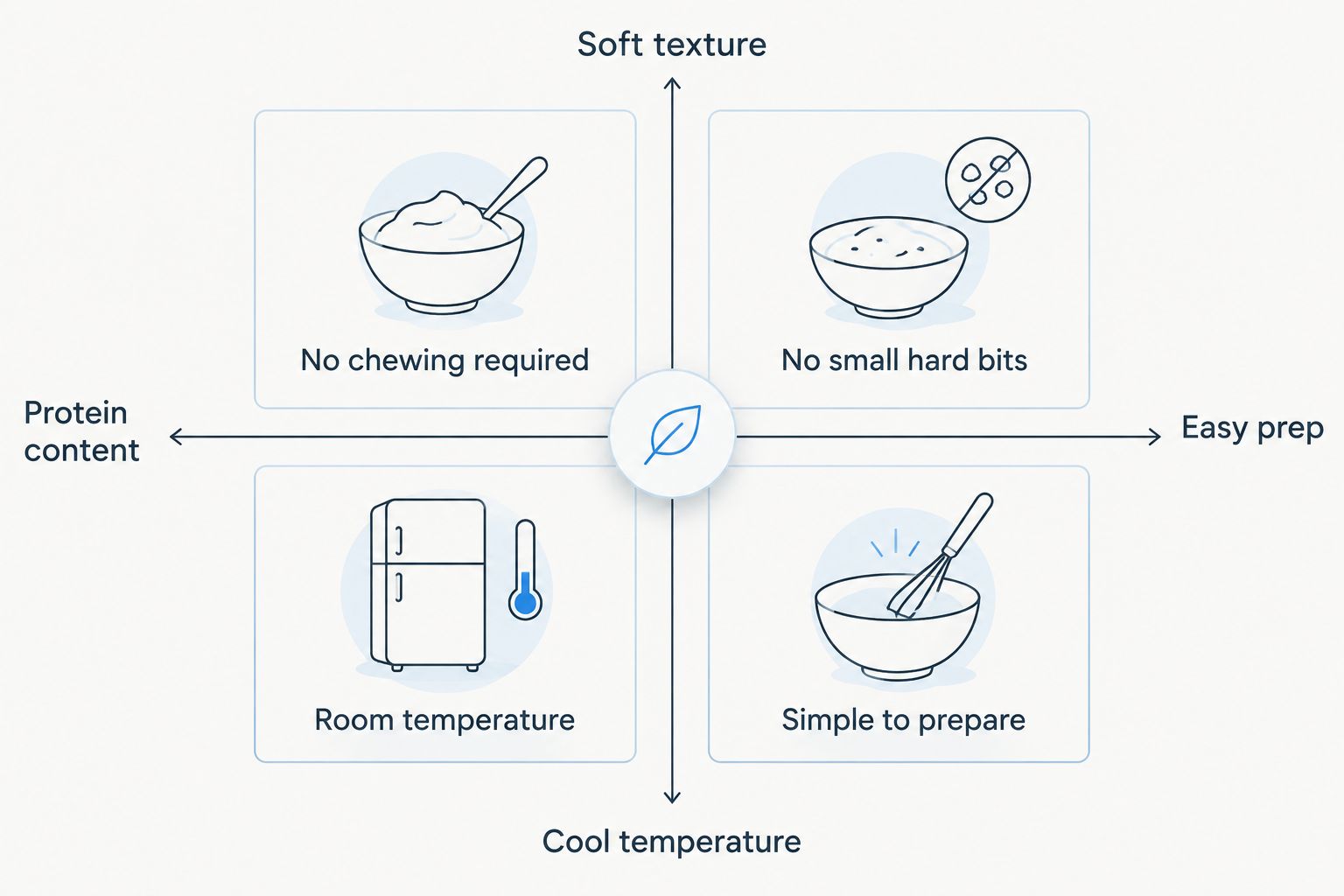
At a glance: best foods after tooth removal
| Food | Best for | Texture notes | Key limitation |
|---|---|---|---|
| Broths and smooth soups | Day 1 recovery | Fully liquid, sip from a cup | Low on calories alone |
| Mashed potatoes | Staying full without chewing | Smooth if mashed well, avoid chunks | Needs added protein |
| Greek yogurt | Protein without chewing | Creamy, cool, no prep | Some brands are sugary |
| Scrambled eggs | Protein once swelling eases | Soft if cooked slow and moist | Needs to be well-cooled, not hot |
| Smoothies (no straw) | Extra calories and vitamins | Blended smooth, sipped from a cup | Suction risk if you use a straw |
| Mashed bananas and applesauce | Budget-friendly recovery food | Naturally smooth, no prep | Lower in protein |
1. Broths and smooth soups: best food after tooth removal for day one
Broth-based soups and pureed vegetable soups are the safest first food after tooth removal. They require zero chewing, deliver fluids you need after surgery, and won't irritate the extraction sites.
Broth and smooth soup pros:
- No chewing at all, even with a numb mouth
- Keeps you hydrated, which matters after anesthesia
- Easy to eat lying down or propped up on a couch
Broth and smooth soup cons:
- Low in calories and protein on their own
- Chunky versions with vegetable pieces should wait a few days
Best for: the first 24 to 48 hours right after surgery. Verdict: Buy in bulk before your appointment.
2. Mashed potatoes: best food after tooth removal for staying full
Mashed potatoes are the classic recovery food because they're calorie-dense, soft, and simple to make bland or flavorful depending on your appetite. Blend in butter or gravy for extra calories once you're a day or two out.
Mashed potato pros:
- Filling in a way broth isn't
- Cheap and easy to make in large batches
- Flexible — add cheese, gravy, or sour cream as tolerance improves
Mashed potato cons:
- Low in protein unless you add cheese or gravy
- Lumpy versions can catch near the extraction site
Best for: patients who feel hungry but still can't chew. Verdict: Buy — a recovery staple for good reason.
3. Greek yogurt: best food after tooth removal for protein
Greek yogurt delivers protein without a single chew, and its cool temperature feels good against swollen gums. It's an easy grab-and-eat option when you don't want to cook.
Greek yogurt pros:
- High protein per serving compared to regular yogurt
- Cold temperature soothes swelling
- No prep beyond opening the container
Greek yogurt cons:
- Some flavored varieties carry a lot of added sugar
- Can feel repetitive after a few days
Best for: protein intake starting day one, continuing through the soft-food period. Verdict: Buy — stock a few flavors.
4. Scrambled eggs: best food after tooth removal once swelling eases
Soft scrambled eggs, cooked low and slow with a little milk, are easy to eat once you're a couple of days out and swelling has started to drop. Let them cool before eating — nothing hot in the first 48 hours.
Scrambled egg pros:
- Solid protein source that's still soft
- Quick to prepare
- Filling compared to yogurt or broth
Scrambled egg cons:
- Best held off until swelling is under control, usually day 2 or 3
- Needs to be fully cooled before eating
Best for: the middle stretch of recovery when you want more substance than yogurt. Verdict: Buy, but wait a day or two first.
5. Smoothies without a straw: best food after tooth removal for extra nutrition
Smoothies pack fruit, dairy, and sometimes protein powder into one easy-to-drink meal. The catch: drink from a cup, never a straw. The suction from straws can pull the healing clot right out of the socket.

Smoothie pros:
- Easy way to fit in fruit and vegetables
- Can add protein powder for extra recovery fuel
- Cool temperature feels good on sore gums
Smoothie cons:
- Straws are off-limits for about a week
- Seeds from berries can get trapped near the extraction site
Best for: rounding out nutrition once broth and yogurt get boring. Verdict: Buy — skip the straw.
6. Mashed bananas and applesauce: best food after tooth removal on a budget
Bananas and applesauce need almost no prep, cost very little, and travel well if you're recovering somewhere other than home. They're gentle on the mouth and easy to keep down even if you're a little queasy from anesthesia.
Mashed banana and applesauce pros:
- Cheapest option on this list
- No cooking required
- Gentle if your stomach is unsettled post-surgery
Mashed banana and applesauce cons:
- Lower in protein than yogurt or eggs
- Not filling enough as a whole meal
Best for: budget-conscious recovery or when you can't get to a store. Verdict: Buy as a backup, not your only food.
How we ranked these foods
Each pick was checked against the same criteria: no-chew texture, safe temperature, calorie and protein value, and how likely small bits are to irritate a healing socket. Foods that failed on texture or temperature — chips, hot soup straight off the stove, seeded bread — didn't make the list at all.
Have questions before your tooth removal?
Ask Dentistry of Tavares about preparation, recovery, and your personal care instructions.
Which food should you choose after tooth removal?
Start with broth and smooth soups the day of surgery. Add Greek yogurt and mashed potatoes by day two, layer in scrambled eggs and smoothies once swelling drops, and keep bananas or applesauce on hand for whenever you need something fast. If you're only stocking your kitchen once, buy broth, yogurt, and mashed potatoes first — that trio covers the hardest 48 hours.
If cost of the extraction itself is on your mind, dental financing plans for major dental work can spread out the expense so recovery planning doesn't get pushed aside.
Any lingering tooth sensitivity once you're back to solid food is common after oral surgery, and toothpaste for sensitive teeth can help ease that transition.
Tooth removal care instructions
Follow the instructions Dentistry of Tavares gives you, since your care may differ based on the tooth removed and your health. These general steps can help protect the area:
- Keep firm pressure on the gauze for the time your dentist recommends. Replace it only as directed.
- Do not rinse, spit forcefully, use a straw, smoke, or vape during the first 24 hours. Suction and pressure can disturb the blood clot.
- Rest with your head raised and avoid strenuous exercise for the first day or as directed.
- Use a cold pack outside the face in short intervals during the first day if your dentist recommends it.
- Take prescribed and over-the-counter medication exactly as directed. Do not place aspirin or other medication directly on the extraction site.
- Start with cool or lukewarm soft foods. Chew away from the extraction area and avoid hot, crunchy, sharp, spicy, seedy, or sticky foods until your dentist says they are safe.
- Keep your mouth clean without disturbing the socket. Brush the other teeth gently. Begin any saltwater rinses only when and how your dentist instructs.
- Call the office if symptoms concern you. Increasing swelling after the first few days, fever, pus, uncontrolled bleeding, severe pain that worsens, or trouble breathing or swallowing needs prompt attention. Call 911 for trouble breathing or swallowing.
Healing times vary. Do not use a general timeline from the internet in place of the instructions provided for your procedure.
FAQ
What’s the best food to eat right after tooth removal?
Broth and smooth, blended soups are the best food right after tooth removal in 2026 because they need no chewing and stay easy on the extraction site. Stick with these for the first 24 to 48 hours.
Can I eat mashed potatoes the day of my tooth removal?
Yes, mashed potatoes are fine the same day as long as they’re smooth and not too hot. Let them cool to room temperature first.
Is yogurt good after tooth removal?
Greek yogurt is one of the better protein sources after tooth removal since it requires no chewing and its cool temperature can soothe swollen gums.
How long do I have to eat soft food after tooth removal?
Most patients stay on soft, no-chew foods for about 3 to 5 days, then slowly reintroduce firmer foods as swelling and soreness ease. Your dentist will confirm timing based on your specific extraction.
Can I drink smoothies with a straw after tooth removal?
No, avoid straws for about a week after tooth removal. The suction can dislodge the healing blood clot and cause dry socket.
What foods should I avoid after tooth removal?
Avoid rice, popcorn, nuts, seeds, chips, and anything crunchy or hard until your dentist clears you. These get trapped near the extraction site and can slow healing.
When can I eat normal food again after tooth removal?
Most patients return to a fairly normal diet within a week to 10 days, though full comfort with tougher foods can take a bit longer depending on how the extraction went.
Are eggs okay to eat after tooth removal?
Soft scrambled eggs are fine once swelling starts to ease, usually by day two or three, as long as they’re cooked soft and cooled before eating.
One last thing
Temperature trips people up more than texture. A soup that's perfectly smooth but served hot straight off the stove can increase swelling and bleeding in the first 48 hours — let everything cool to room temperature or slightly below before eating, even foods that are already on the safe list for 2026 recovery diets.
If pain, swelling, or bleeding seems worse than expected at any point, a same-day dental appointment in Tavares is available when possible rather than waiting it out. Dentistry of Tavares is happy to answer questions before or after your extraction — request an appointment anytime.