How to connect your HSA or FSA card to dental treatment payments
Instead of piecing together dental receipts after every visit, use your HSA or FSA card for eligible dental treatment and save the supporting paperwork as you pay. This 2026 guide explains how to check eligibility, coordinate dental insurance, and choose card payment or reimbursement before your appointment at Dentistry of Tavares.
- To use HSA FSA card for dental treatment, confirm eligibility, payment acceptance, and documentation before paying.
- HSA and FSA funds generally cover qualifying dental care, not teeth whitening done only for appearance.
- Dentistry of Tavares provides general and cosmetic dental care for local patients; confirm benefit-card acceptance before your visit.
- Keep an itemized receipt and insurance explanation of benefits; a successful card transaction does not establish eligibility.
Why this matters
An HSA or health FSA is not dental insurance. It is a separate way to pay qualifying out-of-pocket expenses with tax-advantaged money. Your dental insurance determines what the insurer covers; your benefit account has its own eligibility and documentation rules.
You do not need to connect an HSA or FSA account to the dental office like a software integration. You need an eligible expense, a supported payment method, and records that explain the charge. Confirm those details before treatment so payment questions do not distract from your care.
Dentistry of Tavares is a general and cosmetic dental practice for patients in Tavares, Florida. A treatment's dental purpose matters more than its label: care that treats a dental problem and care done only to change appearance do not receive the same tax treatment.
Before you start
- Account access: Have your active HSA or health FSA card, account access, and administrator contact information. Check your available funds and whether your card needs activation. For a 2026 FSA, confirm the coverage period and claim-submission deadline.
- Appointment materials: Bring your dental insurance information and ask for an itemized treatment estimate. Confirm whether the office accepts your particular benefit card and can provide the documents your administrator requires.
- The easy-to-miss issue: A card approval is not proof that an expense qualifies. Insurance can also change your final responsibility after a claim is processed, so keep the receipt and reconcile it with your insurance paperwork.
If payment makes you nervous, bring a written list of questions. Ask the office to explain the treatment and payment steps separately, in everyday language. You do not need to make sense of every account rule while sitting in the dental chair.
Eligibility check
- Identify the treatment you are paying for. Ask what dental condition it addresses and whether the estimate includes separate cosmetic services.
- Check the expense against your administrator's guidance and the IRS rules for qualified medical expenses. IRS Publication 502 addresses dental treatment; Publication 969 explains HSAs and other tax-favored health plans.
- Verify the timing. An HSA expense must generally be incurred after the HSA was established. A health FSA expense generally must be incurred during your eligible coverage period, subject to the plan's rules.
- Ask your administrator about unclear items before authorizing payment. Describe the actual procedure rather than asking whether all dental work is covered.
Expected result: You know which services qualify and which need a separate payment method.
Dental exams, cleanings, fillings, and treatment for dental disease generally qualify. Orthodontic treatment also generally qualifies. Teeth whitening done only for appearance does not qualify, and purely cosmetic dental procedures generally do not qualify.
Do not assume that every service in a smile-improvement plan receives the same treatment. A plan can include both restorative care and appearance-only work. Ask for those services to be identified separately, then check the eligibility of each expense.
For medically related expenses whose eligibility is unclear, ask the administrator what supporting information it needs. A dentist's explanation helps describe the treatment, but it does not automatically override account rules.
Insurance coordination
- Give the office your current dental insurance information before treatment. Ask whether the estimate reflects expected insurance benefits or whether the full charge is initially your responsibility.
- Separate the treatment estimate from the final insurance decision. An estimate is useful for planning, but it does not guarantee what the insurer will pay.
- Identify the amount you are paying yourself. Use HSA or FSA funds only for qualifying expenses that are not reimbursed by insurance or another source.
- Review the explanation of benefits when it arrives. Compare its patient-responsibility amount with the payment receipt, and ask the office about any difference.
Expected result: Your benefit-account payment matches an eligible out-of-pocket expense, with a clear process for resolving adjustments.
An explanation of benefits, often called an EOB, explains how the insurer processed the claim. It is not a payment receipt. Keep both documents when they are available because they answer different questions: what insurance allowed and what you actually paid.
For your 2026 dental visits, record which expenses insurance paid and which expenses you paid. Do not request HSA or FSA reimbursement for a charge that insurance already reimbursed. You also cannot use both accounts to reimburse the same expense.
If you need help separating coverage, deductibles, and patient responsibility, read the guide to understanding your dental insurance. The benefit account pays eligible expenses; it does not change the insurance policy's coverage terms.
Payment route
There are 2 payment routes: pay directly with the benefit card, or pay another way and request reimbursement. Choose based on card acceptance, available funds, and your administrator's instructions—not on the assumption that one route makes a procedure eligible.
| Payment route | Best for | Advantage | Limitation |
|---|---|---|---|
| Direct HSA or FSA card payment | Patients with a supported, active card and sufficient funds | Pays an eligible charge from the account at the time of payment | Card approval can still require documentation; a declined card needs follow-up |
| Pay first, then request reimbursement | Patients whose card cannot be used or who prefer to submit a documented claim | Keeps the payment separate from the administrator's reimbursement process | Requires another payment method, paperwork, and administrator processing |
- Confirm card acceptance before your visit. Ask whether your HSA or FSA card can be used for the planned charge; do not assume every card works with every payment system.
- Check the account's available funds. An HSA debit card generally accesses money already in the account; a health FSA follows its plan's available-benefit rules.
- Agree on the amount to charge. If eligible and ineligible services appear together, ask whether the payments can be separated. If funds are insufficient, ask about dividing payment between methods.
- Pay using the confirmed method and request an itemized receipt. If the benefit card fails, contact the administrator or use another accepted method and follow the reimbursement process.
Expected result: The charge is paid, you know which account funded it, and you have documentation for that expense.
Card acceptance and tax eligibility are separate checks. Neither a successful transaction nor a dental office's merchant classification turns an ineligible service into a qualified expense.
Avoid entering your benefit-account password into an unfamiliar payment link. Use your administrator's official account access for account management and the dental office's confirmed payment process for the appointment.
Receipt records
- Collect 3 supporting documents when applicable: the itemized receipt, the insurance EOB, and the administrator's claim confirmation.
- Check that the receipt identifies the patient, provider, service date, treatment, and amount paid. A bank statement alone usually does not explain what dental service you received.
- Save the documents together with a short record of the account used. For your 2026 records, distinguish card transactions from reimbursement requests so you do not submit the same expense twice.
- Respond promptly if the administrator requests proof. Submit the requested documents through its official process and keep the confirmation.
Expected result: You can explain the expense without reconstructing the appointment from memory.
A simple sequence keeps the paperwork manageable: confirm eligibility, reconcile insurance, choose payment, and save records. Each step answers a different question, so completing payment does not replace the other checks.
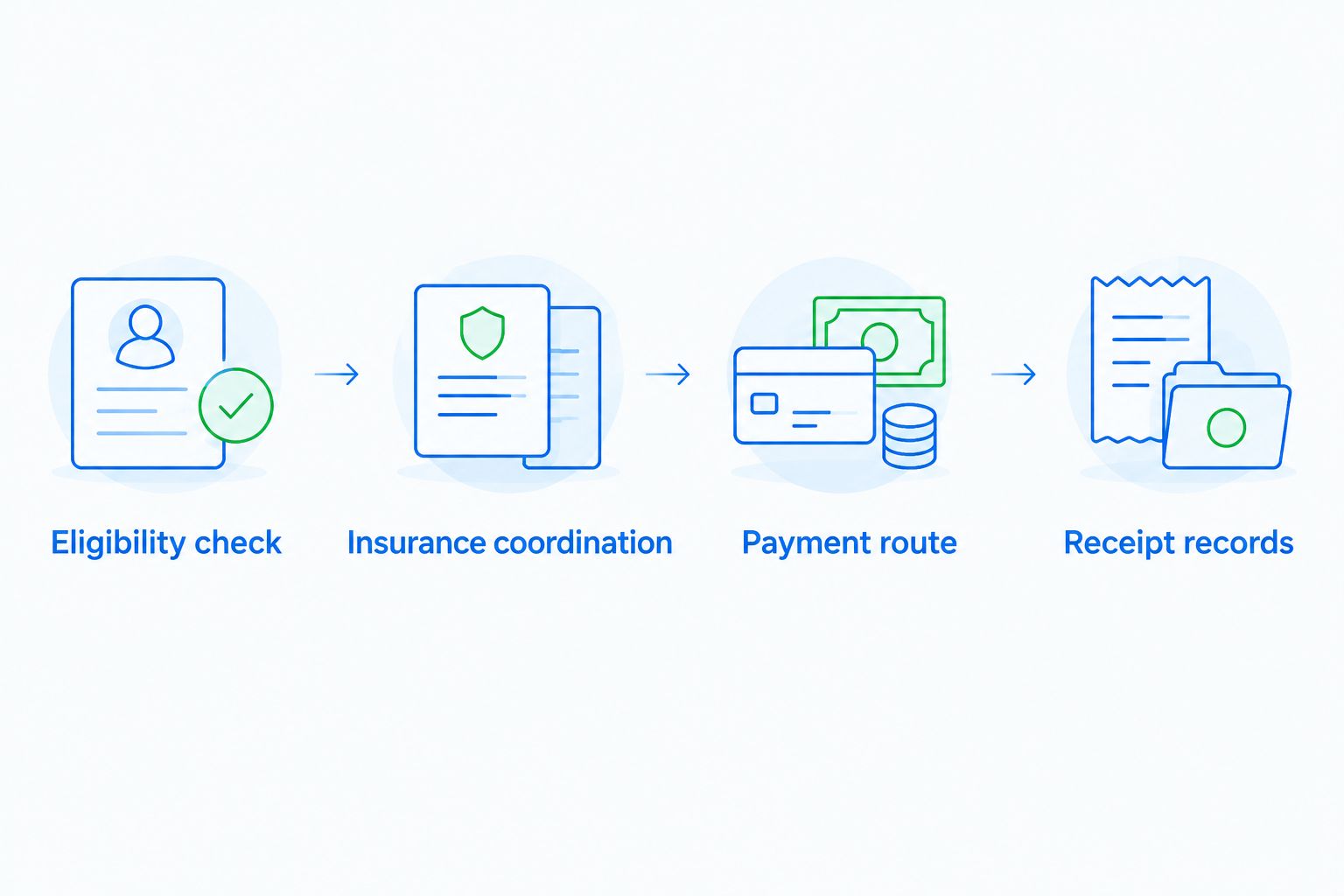
Ask the administrator how long to retain your records and follow the tax-record requirements that apply to your account. An HSA custodian does not necessarily review every expense when you spend the money; you remain responsible for documenting qualified distributions.
Request reimbursement after paying another way
Use reimbursement when you have already paid an eligible dental expense yourself. This route does not require linking your dental office to your benefit account.
- Gather the itemized receipt and any insurance EOB. Confirm that the amount requested excludes insurance payments and other reimbursements.
- Open your administrator's official reimbursement process. Select the expense or claim option described in its instructions; names and screens differ between administrators.
- Enter the patient, provider, service date, expense description, and eligible amount as requested. Attach the required documents and follow the administrator's submission steps.
- Save the confirmation and monitor requests for additional information. Record the completed reimbursement against the original expense.
Expected result: You have 1 reimbursement request for the eligible amount, with documents attached and a record of its status.
For an HSA, reimbursement can generally occur later for a qualifying expense incurred after the account was established, provided you keep records and have not already reimbursed or deducted that expense. A health FSA follows its coverage and submission deadlines; do not apply HSA timing rules to an FSA claim.
Orthodontic payment arrangements deserve a separate check. Health FSAs can have special rules for orthodontic advance payments, so confirm the required dates and documentation before paying a deposit or submitting installments.
Troubleshooting
The benefit card is declined
Check activation, available funds, card expiration, and any administrator restrictions. Ask the administrator for the decline reason rather than repeatedly retrying the charge. If treatment payment is due, ask the office which other payment methods it accepts and check reimbursement eligibility.
The administrator asks for more proof
Submit an itemized receipt showing the service and date, plus the EOB if requested. A payment-terminal slip often shows only the transaction amount. Ask the office for treatment details if your existing receipt does not identify the service.
Insurance changes the amount after you pay
Compare the final EOB with the original payment and contact the office about the adjustment. If money is refunded after an HSA or FSA payment, ask the administrator how to handle the refund correctly; do not assume it belongs in your regular spending account.
The estimate combines restorative and cosmetic care
Request separate descriptions and amounts for the services. Pay only qualifying expenses with benefit funds. If you already used the account for an ineligible expense, contact the administrator about correction rather than submitting unrelated receipts.
Your FSA deadline is approaching
Check both the service-date rules and the claim-submission deadline. A run-out period allows claim submission; it does not necessarily extend the period for receiving care. Carryover and grace-period provisions depend on the plan, so confirm your own rules.
Customize your workflow
For ongoing dental care, keep one folder for treatment records and one expense log showing insurance payments, benefit-card payments, and reimbursements. Review the log after each EOB arrives. This helps prevent duplicate claims without adding a complicated system.
For larger treatment plans, ask for an itemized schedule that separates planned services from completed services. Then check eligibility and timing with your administrator before paying ahead. Do not rush a treatment decision just to spend remaining account funds.
Dentistry of Tavares offers general, cosmetic, and restorative dental care. Tell the office what you want explained before treatment, including any payment questions or dental anxiety, and confirm account-specific rules with your benefits administrator.
FAQ
Can I use an HSA or FSA card for dental treatment?
Yes, you can use HSA or health FSA funds for qualifying dental expenses that are not reimbursed elsewhere. Confirm the procedure’s eligibility and the office’s card acceptance before paying.
Do I need to connect my HSA account to the dentist?
No, you generally do not need to connect your HSA account to the dental office. Pay with a supported benefit card or pay another way and follow your account’s reimbursement process.
Can I use my HSA or FSA for teeth whitening?
Teeth whitening done only for appearance is not a qualified dental expense. Use a separate payment method for that service, even if it appears alongside eligible dental treatment.
Can I use an HSA or FSA for clear aligners?
Orthodontic treatment generally qualifies for HSA or health FSA payment. Confirm your treatment’s eligibility and ask about documentation and any FSA rules for advance payments or installments.
Can I use dental insurance and an FSA for the same visit?
Yes, dental insurance and a health FSA can both apply to a visit, but not to reimburse the same expense twice. Use FSA funds for the qualifying amount that remains your responsibility after other reimbursements.
Does Dentistry of Tavares accept my HSA or FSA card?
Confirm your specific card’s acceptance with Dentistry of Tavares before your appointment. Card acceptance does not establish whether a treatment qualifies under your account’s rules.
What happens if my dental benefit card is declined?
Contact your administrator to identify the reason for the decline. If you pay with another accepted method, keep the itemized receipt and request reimbursement only if the expense qualifies.
Do I have to submit my FSA claim before the end of 2026?
Your FSA plan determines the claim-submission deadline, so do not assume it is the last day of 2026. Check the coverage period, run-out deadline, and any grace-period or carryover provisions separately.
One last thing
The receipt matters even when the card works. Save it before leaving the office, while requesting a clearer copy is easy. For your next 2026 visit, ask about treatment, insurance, and benefit-card payment before the appointment—not after a documentation request arrives.
Related guides
- Clear aligners for teenagers
- Dental financing plans for major dental work
- Teeth whitening methods compared
Request an appointment with Dentistry of Tavares and bring your treatment and payment questions. Ask for clear explanations so you can make your next decision with confidence.