Best Teeth Whitening Methods Ranked by Results (2026)
Teeth whitening in 2026 ranges from a one-hour dentist visit to a $10 tube of toothpaste, and the method you pick determines whether people notice a real change or nothing at all. Best overall: in-office professional whitening. Best for sensitive teeth: custom take-home trays from your dentist. Best budget option: over-the-counter whitening strips.
- In-office professional whitening gives the fastest, most dramatic results among teeth whitening methods available in 2026.
- Custom take-home trays from a dentist whiten evenly with less sensitivity than one-size-fits-all strips.
- Whitening strips cost less but move slower and can miss teeth with uneven curves or gaps.
- Whitening toothpaste only lifts surface stains from coffee or wine — it can’t change the tooth’s natural color.
- Crowns, veneers, and bonded teeth don’t whiten with any method, so check with your dentist before you start.
Why this matters
Most people try whitening because of a specific event or because coffee, wine, or tobacco stains have built up over the years, and the wrong method wastes both time and money. A drugstore strip that works fine on flat front teeth can leave crowded or curved teeth streaky, while a professional treatment can feel like overkill for someone who just wants to maintain results between cleanings. The team at Dentistry of Tavares sees both outcomes regularly — patients who whitened at home for months with barely any change, and patients who spent money on in-office treatment they didn't need.
Matching the method to your starting shade, your sensitivity level, and your dental work (crowns, veneers, fillings) prevents both problems. That's the whole point of ranking these methods by actual results instead of by price alone.
What makes the best teeth whitening method
- Speed of visible results — how many sessions or days before you notice a change
- Strength and safety of the whitening agent — peroxide concentration and whether a professional is supervising it
- Sensitivity control — how much the method irritates teeth and gums during and after treatment
- How long results last — whether you need frequent touch-ups or occasional maintenance
- Fit with existing dental work — crowns, veneers, and bonding do not lighten with any whitening method
- Cost and payment fit — whether the method requires a dental visit or fits into an existing routine
Teeth whitening methods at a glance
| Method | Best For | Standout Feature | Key Limitation |
|---|---|---|---|
| In-office professional whitening | Fast, dramatic results before an event | Full shade change in a single visit | Temporary sensitivity is common afterward |
| Custom take-home trays | Sensitive teeth and gums | Gel dose spread over several days, gentler on gums | Takes longer to see full results |
| OTC whitening strips | Budget-conscious first-timers | Simple, no dental visit needed | Gel misses gumline and between teeth |
| Whitening toothpaste | Maintaining results | Fits into your existing brushing routine | Removes surface stains only, no shade change |
| LED at-home kits | Touch-ups between visits | Low-effort maintenance at home | Little evidence the light adds much benefit |
1. In-office professional whitening: best teeth whitening method for fast, dramatic results
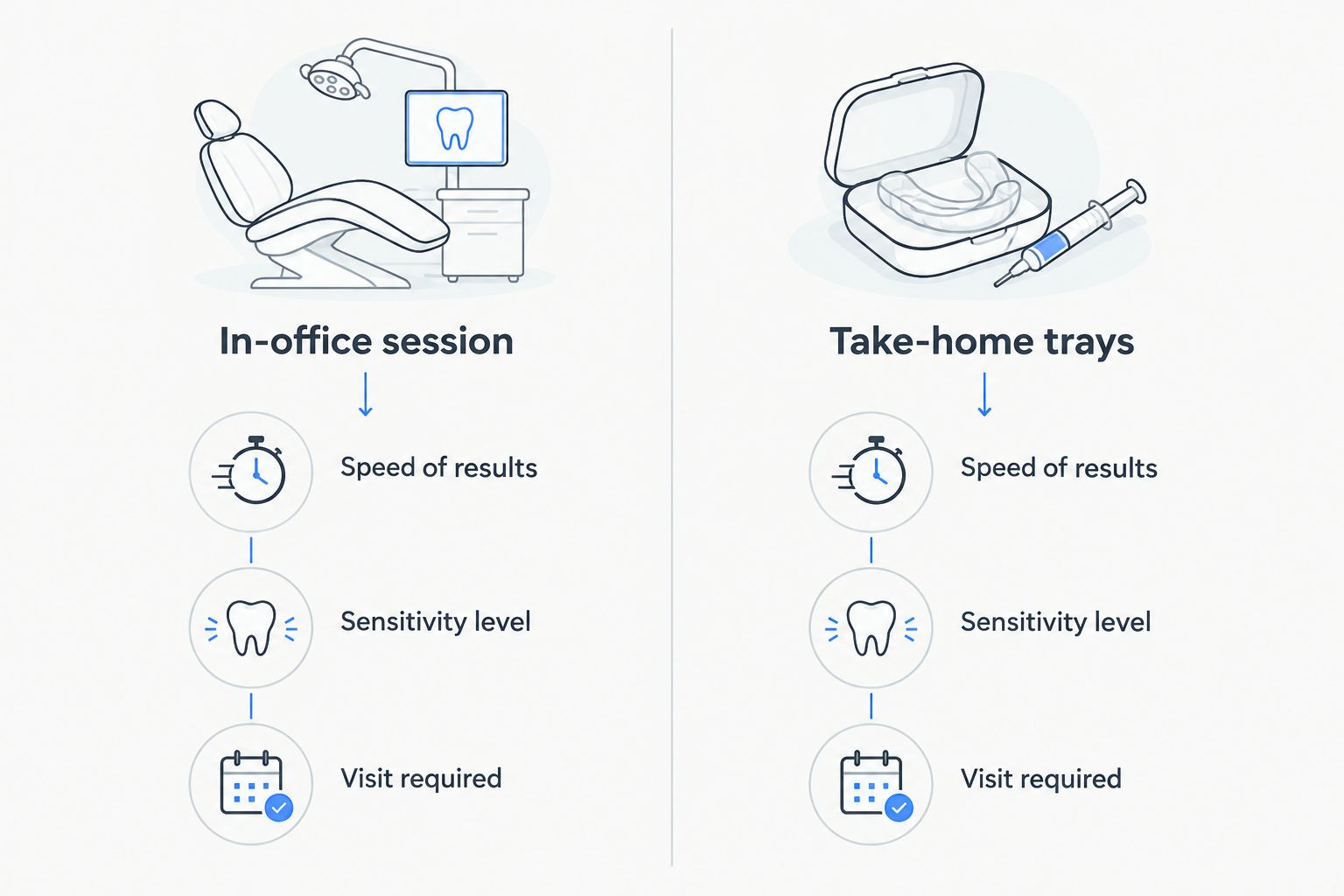
A dentist applies a high-concentration peroxide gel directly to your teeth, often paired with a special light to speed the reaction, and the whole process usually wraps up in one office visit. Because the gel strength is high and a professional is watching for gum contact, the shade change is more noticeable than anything sold over the counter.
In-office whitening pros:
- Fastest visible change of any teeth whitening method
- Even shade result across all teeth, including molars
- A dentist monitors gum protection during application
- Usually finished in a single appointment
In-office whitening cons:
- Temporary sensitivity in the first day or two is common
- Results fade faster without occasional touch-ups
- Costs more upfront than at-home options
In-office whitening best for: anyone who wants a visibly whiter smile before a wedding, reunion, or big event and doesn't want to wait weeks for results. Patients who get nervous about dental visits can ask about sedation dentistry options for anxious patients — many whitening appointments are quick, but comfort options exist for anyone who needs them.
Verdict: Buy.
2. Custom take-home trays from your dentist: best teeth whitening method for sensitive teeth
Your dentist takes an impression of your teeth to build trays that fit snugly, then sends you home with a lower-concentration gel and a schedule for how long to wear them each day. Spreading the whitening agent over several days instead of one sitting is easier on sensitive gums and enamel.
Custom trays pros:
- Less sensitivity than in-office treatment because the dose is spread out
- Trays fit precisely, so gel touches less gum tissue than generic strips
- Results last longer, with easy refill gel for touch-ups
- You control the pace from home after the initial fitting
Custom trays cons:
- Full results take longer to show than a single in-office visit
- Requires daily discipline to wear the trays as directed
- Still needs one dental visit to get properly fitted
Custom trays best for: people with sensitive teeth or gums who still want professional-level whitening without sitting through a longer chairside session. If cost is the hesitation, ask about dental financing plans for major dental work — most practices, including Dentistry of Tavares, work with patients on payment options for cosmetic treatments like this.
Verdict: Buy.
3. Over-the-counter whitening strips: best teeth whitening method for a budget-friendly start
Thin, flexible strips coated with a peroxide gel press directly onto your teeth for a set time each day, with no dental visit required. They're the most accessible teeth whitening method on this list and the easiest to try without committing to anything.
Whitening strips pros:
- Budget-friendly compared to professional treatment
- Available at most pharmacies without an appointment
- Simple to use as part of an evening routine
- Can be repeated periodically for touch-ups
Whitening strips cons:
- Gel doesn't reach between teeth or along the gumline the way trays do
- Results are more gradual and less dramatic than professional options
- Uneven teeth shape can cause streaky or patchy whitening
Whitening strips best for: people trying whitening for the first time on a budget, or maintaining results between professional treatments.
Verdict: Hold — a reasonable starting point, but not the top pick if you want a real shade change.
4. Whitening toothpaste: best teeth whitening method for maintaining results
Whitening toothpaste relies on mild abrasives, and sometimes a small amount of peroxide, to lift surface stains left behind by coffee, wine, or tobacco during regular brushing. It's a maintenance tool, not a stand-alone whitening treatment.
Whitening toothpaste pros:
- Easiest habit to keep up since it replaces your regular toothpaste
- Inexpensive and widely available
- Helps preserve results from in-office or tray whitening
- No extra step added to your day
Whitening toothpaste cons:
- Cannot change the tooth's actual underlying color
- Results build slowly, often over several weeks
- Not effective as a primary whitening method on its own
A good option here is whitening toothpaste for coffee and wine stains, which is built specifically for the surface stains that build up from daily habits.
Whitening toothpaste best for: anyone maintaining results after a professional treatment or trying to prevent new surface stains from setting in.
Verdict: Buy — as a maintenance step, not as your only whitening method.
5. LED at-home whitening kits: best teeth whitening method for touch-ups between visits
These kits pair a peroxide gel, usually weaker than what a dentist uses, with a blue LED light meant to speed up the whitening reaction over multiple at-home sessions. They sit between strips and professional trays in terms of effort and cost.
LED kit pros:
- Convenient for touch-ups without booking an appointment
- Can extend results from an earlier professional whitening treatment
- No dental visit required to use
LED kit cons:
- Evidence that the light meaningfully speeds whitening beyond the gel alone is thin
- Results vary widely by brand and gel strength
- Overuse can cause sensitivity, similar to strips
LED kit best for: someone who already whitened professionally and wants a low-effort way to maintain results at home between visits.
Verdict: Wait — try other methods first, and treat this as a supplement, not a starting point.
How we ranked these teeth whitening methods
Each method was weighed against the same criteria: speed of results, strength and safety of the whitening agent, sensitivity control, how long results last, fit with existing dental work like crowns and veneers, and cost fit. In-office whitening and custom trays score highest because a dentist controls the gel strength and application, which protects gums and produces a more even result than anything self-applied without guidance.
“If a whitening method doesn’t address the cause of the stain, the color comes back the same way it left.”
Which teeth whitening method should you choose?
If you want the biggest, fastest change and don't mind a little sensitivity for a day or two, in-office professional whitening is the default pick for 2026. If your teeth or gums are sensitive, or you'd rather whiten gradually at home after a proper fitting, custom take-home trays are the better fit. If you're just testing the waters or maintaining results on a budget, whitening strips and whitening toothpaste round out a sensible routine — just don't expect either one to replace a professional treatment on its own.
Ready to talk teeth whitening options?
Find out which whitening method fits your smile and comfort level.
FAQ
What’s the best teeth whitening method for sensitive teeth?
Custom take-home trays from a dentist are usually the gentlest option because the gel dose is spread over several days instead of applied all at once. A dentist can also adjust the gel strength if sensitivity shows up during treatment.
How much whiter can professional teeth whitening make my teeth?
In-office professional whitening typically lightens teeth several shades in a single visit, more than at-home strips or toothpaste achieve on their own. Results vary based on your starting shade and the type of staining involved.
Is teeth whitening safe for crowns and veneers?
Whitening treatments don’t change the color of crowns, veneers, or bonded teeth, so those areas can end up a different shade than your natural teeth after whitening. Talk to your dentist before starting if you have visible dental work.
How long do teeth whitening results last?
In-office whitening results generally fade faster without touch-ups, while custom tray results tend to last longer with occasional refill gel. Daily habits like coffee, wine, and tobacco use also affect how quickly stains return.
Can whitening toothpaste really lighten teeth on its own?
No — whitening toothpaste only removes surface stains and doesn’t change the tooth’s natural underlying color. It works well as a maintenance step after a professional or take-home whitening treatment.
Are over-the-counter whitening strips as effective as in-office whitening?
Whitening strips work more gradually and can miss areas between teeth or along the gumline that a dentist-applied treatment reaches evenly. They’re a reasonable budget option but rarely match the shade change of in-office whitening.
How much does professional teeth whitening cost in 2026?
Cost varies by practice and by whether you choose in-office treatment or take-home trays, so it’s worth asking your dentist directly for current options. Many practices also offer payment plans for cosmetic treatments like whitening.
Can I get teeth whitening done the same day?
Same-day in-office whitening is available at many practices when scheduling allows, though it’s worth confirming availability directly since appointment slots vary. Take-home trays require an initial fitting visit before you start whitening at home.
One last thing
Most people don't realize that whitening order matters if crowns, veneers, or bonding are part of the plan — whitening natural teeth first, then matching any new dental work to that final shade, avoids a mismatched smile down the road. Ask about this before starting any whitening method in 2026, especially if a crown or veneer is somewhere in your future.
Dentistry of Tavares works with patients on which teeth whitening method fits their teeth, sensitivity, and budget, so reach out and request an appointment to talk through the right starting point for your smile.